banner-news1
REPAIR FAQ
Back

HOWO TX MAX Chassis Noise: Spring, Bushing and Torque Rod Checks

Short answer: chassis noise on a TX MAX is almost always a clearance problem, not a broken part. The trick is to match the noise to the manoeuvre that produces it: a knock over potholes at one wheel points to the shock absorber or the spring eye, a clunk on cornering points to the torque rod or the anti-roll bar bush, and a bang on take-off or braking points to a loose U-bolt or a worn joint. Get that match right and you find the part with a pry bar instead of a parts cannon.

Tipper and mixer duty on these trucks is brutal on the suspension. Full load on rough ground works every bushing in the linkage, and the first sign is noise rather than looseness, because the driver hears it before the steering feels it.

QUICK DIAGNOSIS — match the noise to the manoeuvre
  1. 1Bang on take-off or braking — loose U-bolts, worn spring eye bush or a shifting spring saddle.
  2. 2Clunk when cornering — torque rod ball joint, anti-roll bar link or cab mount, not the spring.
  3. 3Rattle over small bumps at one wheel — shock absorber with a dead zone, or a broken spring leaf.
HOWO TX MAX tipper working on a earthworks site at dusk, the duty where chassis noise first appears

TX MAX on earthworks duty. Load and rough ground find every loose clearance in the linkage.

1. Build the noise profile before you lift the truck

Write down four things and the fault field narrows immediately:
  • When — take-off, braking, cornering, steady speed, or over bumps.
  • Where — front axle, rear bogie, mid-chassis, or under the cab.
  • Loaded or empty — a noise that only appears loaded is a clearance that closes under weight.
  • Frequency — a single knock is a joint; a rapid rattle is a worn bush or a broken leaf.
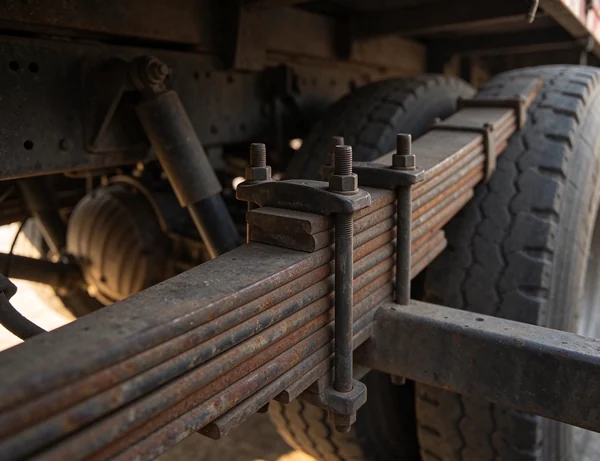
Rear leaf spring and U-bolt clamp on a HOWO TX MAX chassis, inspected for looseness and interleaf wear

Spring pack and U-bolt clamp. Look for polished rub marks where the leaves have been moving against each other.

2. The five checks that cover most cases

  1. U-bolts and saddle. Check for a gap between the spring pack and the axle saddle, and for a rust line that has been broken by movement. Re-torque to specification, and renew any U-bolt that has been stretched or has damaged threads — do not reuse a stretched U-bolt.
  2. Interleaf friction. Dry, rusted leaves sliding against each other produce a creak that sounds like a failing component. Look for bright polished patches between leaves. Clean and apply the specified interleaf lubricant; do not use general-purpose grease, which collects grit and accelerates wear.
  3. Shock absorbers. Remove one and work it by hand through its full stroke. Resistance should be smooth and firm in both directions with no dead zone and no free travel at the start of the stroke. Any oil film on the body means it is finished.
  4. Torque rods and ball joints. With the truck on the ground and the parking brake released, bar the joint with a pry bar while a helper watches the housing. Visible movement before the housing moves means a worn ball joint or a loose clamp.
  5. Bushings and crossmember mounts. Check every rubber bushing for cracks that go through the wall, and for rubber that has extruded out of its housing. A bushing that has gone soft lets the component move further than the design allows, and the noise is the clearance opening and closing.
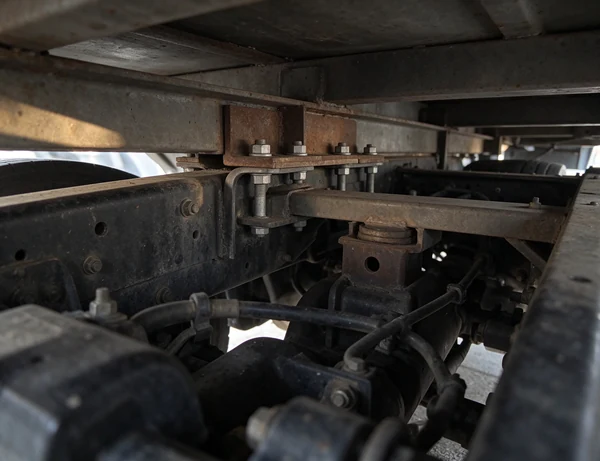
Torque rod ball joint and clamp on a HOWO TX MAX rear suspension, checked for play

Torque rod joint. Play here shows as a clunk on cornering and as rear axle steer under load.

3. What each noise usually means

Manoeuvre that produces it Most likely component Confirmation method
Take-off or brake application U-bolt, spring saddle, spring eye bush Bar the pack while loaded; check for saddle witness marks
Cornering at low speed Torque rod joint, anti-roll bar link Pry test with the truck on its wheels
One wheel over a bump Shock absorber, broken leaf Hand-stroke the shock; inspect the pack for a displaced leaf
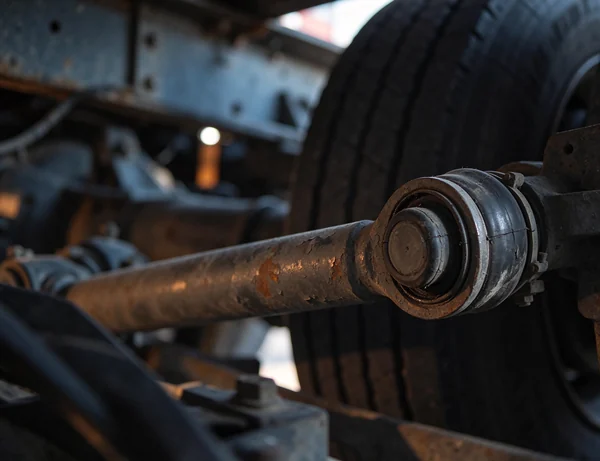
Steady speed, road-speed frequency Driveshaft universal joint, wheel bearing Check joint play; jack the wheel and check for bearing rumble
Under the cab, over rough ground Cab mount or cab air spring Inspect mounts and check the cab level valve
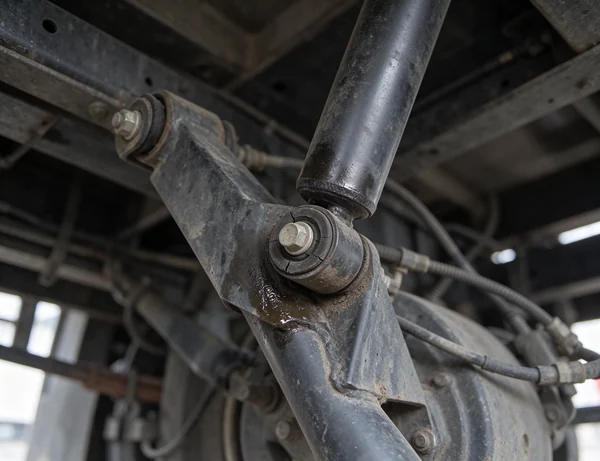
Rear shock absorber and cracked bushing on a Sinotruk TX MAX chassis, inspected during suspension diagnosis

Shock absorber and its bush. A crack through the bush wall is a replacement, not a repair.

4. Mistakes that keep the noise coming back

Do not diagnose suspension noise with the truck lifted by the chassis. With the axle hanging, every clearance is open and nothing will reproduce the noise. Load the suspension the way it works on the road — on its wheels, or on a lift that supports the axle at ride height.
  • Replacing the spring pack for a loose U-bolt. The pack is usually fine; the clamp has lost its preload.
  • Fitting a new shock to fix a broken leaf. The shock was doing extra work because the spring had failed.
  • Ignoring a torque rod because “it only knocks in the yard”. Rear axle steer under load wears tyres and destabilises braking.
  • Greasing rubber bushings. Most of these are designed dry; petroleum grease degrades the rubber.
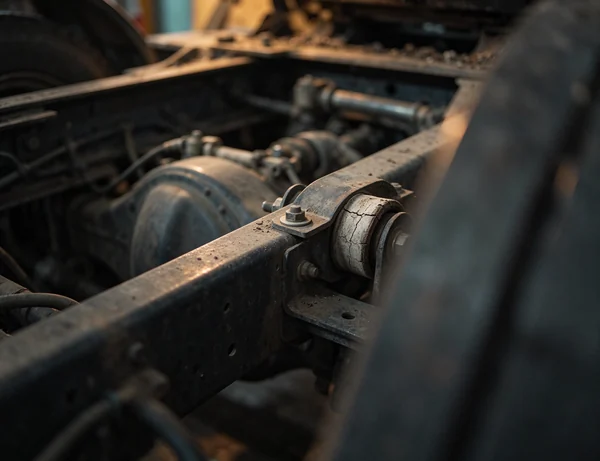
Cracked rubber crossmember bushing on a HOWO TX MAX frame, a common source of chassis noise

A bushing cracked through the wall. Once it opens up, the component moves and the noise starts.

5. Repair or replace

Item Repair Replace
Leaf spring Clean and lubricate interleaf surfaces, re-clamp Cracked or displaced leaf, or a pack that has lost its camber
U-bolt — Always renew after removal; never reuse a stretched bolt
Shock absorber — Dead zone, oil film or a broken bush
Torque rod joint Re-shim only if the manufacturer allows it Any visible play; sealed joints are not adjustable
Rubber bushing — Crack through the wall, or rubber extruded from the housing

6. Questions drivers ask most

Why does the noise only appear with a full load?
Because load closes clearances. An empty truck lets a worn joint sit still; a loaded one moves it through the worn zone on every bump. Noise under load means wear, not a loose bolt.
Can I grease the leaf springs to stop the creaking?
Only with the lubricant specified for interleaf use. General grease traps grit between the leaves and wears them faster. If the creak comes from polished, dry leaves, cleaning and correct lubrication does fix it.
Is a clunk on cornering dangerous?
It indicates a worn torque rod or link, which allows the axle to steer slightly under load. That affects stability and tyre wear. It will not fail instantly, but it should be fixed before the next long trip.
How do I tell a wheel bearing from a universal joint?
Bearing noise changes with cornering load and often disappears when the wheel is unloaded. Joint noise follows road speed and is usually worse under acceleration or coasting, and shows as play when you twist the shaft by hand.
Need spring packs, U-bolts, shocks, torque rods or bushings for your TX MAX? Send the chassis number and we will confirm the correct axle specification. Send your request

Torque values and bushing specifications vary by axle and suspension build. Confirm the figures for your chassis in the OEM workshop manual before re-torquing.

Need Help or Want More Detailed Maintenance Information?

Please contact our team for personalized maintenance guidance and technical support for your Sinotruk HOWO, A7, or T7 trucks. We provide professional advice and recommendations for genuine parts to help ensure the reliable operation of your fleet.

Contact Us
More Articles

Howo Sinotruk Parts & Catalog PDF

Whenever your truck needs repair, you don’t know how to buy the right parts?

Don’t worry, we have already done this job for you. We have a complete parts list catalog for different models of each truck assembly, you can choose the right catalog to download and collect according to your truck configuration.

When you have a need, you can send us your required list based on this catalog.

Obtain the complete Howo truck parts catalog PDF file and pricing.

Contact Us
Hot-Selling Replacement Parts

whatsapp-4