banner-news1
REPAIR FAQ
Back

HOWO T7H Turbo Failure: Root Causes Before You Replace It

Short answer: a turbocharger almost never fails on its own. On the T7H it fails because something upstream or downstream destroyed it — dust from a leaking air filter, oil starvation from a restricted feed or a hot shutdown habit, a restricted oil drain, or exhaust temperature far above design. If you fit a new turbo without finding that cause, the second one will fail the same way, usually inside a few thousand kilometres.

That is the single most useful fact in this article. A warranty claim on a turbo that lasted 20 000 km is almost always a claim about the air filter, the oil or the driver’s shutdown routine, not about the part.
QUICK DIAGNOSIS — the four root causes, in order of frequency
  1. 1Dust ingress. Filter element damaged, housing not sealed, or the intake pipe cracked after the filter.
  2. 2Oil starvation or coking. Restricted feed line, low oil pressure, or shutdown straight from full load.
  3. 3Restricted oil drain. Carbon in the return pipe raises housing pressure and pushes oil past the seals.
  4. 4Excessive exhaust temperature. Late injection timing, boost leaks, over-fuelling or a blocked aftertreatment.
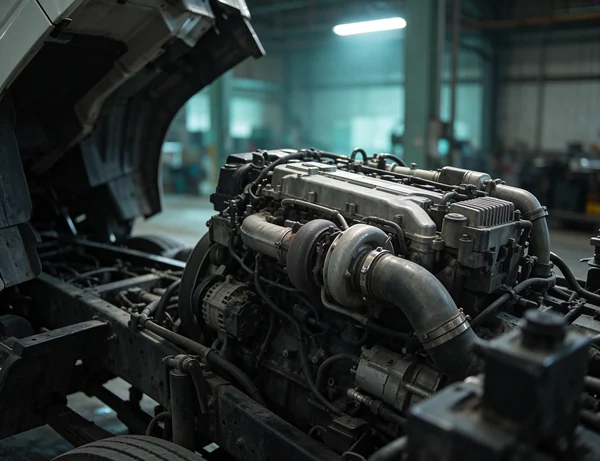
HOWO T7H engine bay with the cab tilted forward, showing the turbocharger location on the MC11 engine

T7H with the cab up. The turbo is easy to reach and easy to condemn without checking the causes.

1. Read the failure mode — it names the cause

Every failed turbo tells you which of the four causes killed it, if you look at the right surface:
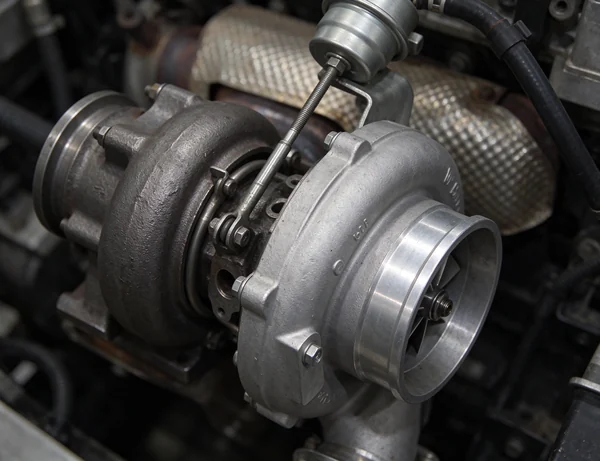
Turbocharger body from a HOWO MC11 engine with heat discolouration on the turbine housing

Heat discolouration on the turbine side is normal. Cracking and heavy scaling is not.
  • Compressor wheel blades eroded at the leading edges, tips sand-blasted — dust. Go straight to the air filter and every joint between it and the compressor inlet.
  • Bearing blue or blackened, shaft scored, wheel contacting the housing — oil starvation or oil that broke down from heat. Check feed pressure, feed line restriction and shutdown routine.
  • Oil wet compressor side, oil in the intercooler, dry turbine side — drain restriction or excessive crankcase pressure pushing oil past the seal.
  • Turbine wheel with heat cracks, blades distorted or a housing crack — exhaust temperature too high. Check injection timing, boost leaks, aftertreatment restriction and load history.
  • Foreign object damage — a valve head, a broken piston ring fragment or a gasket piece. That is an engine repair, not a turbo repair.

2. Air side: the checks that actually find the cause

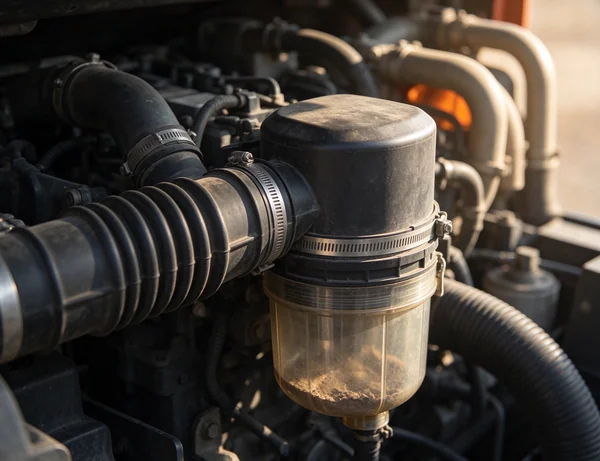
Air filter housing and dust bowl on a Sinotruk T7H, inspected for element damage and seal leaks

Filter housing and dust bowl. The seal at the outlet end matters as much as the element itself.
  1. Open the housing and inspect the element for a tear, a crushed pleat or a distorted seal. Hold it up to a light — pin holes show up immediately.
  2. Check the seal surface where the element seats. A dried, hardened or missing seal lets air bypass the filter entirely, and the dust goes directly into the compressor.
  3. Inspect the intake pipe after the filter for cracks, chafing and loose clamps, especially at the bellows section. A cracked pipe is an unfiltered air path.
  4. Check the dust ejection valve on the housing. If it is missing or stuck open, the housing no longer separates dust and the element works far harder.
  5. Look inside the compressor inlet for a dust track pattern. A polished, sand-blasted finish on the blades confirms long-term ingestion.

3. Oil side: pressure, restriction and shutdown

  • Feed pressure at the turbo inlet. Measure it, do not assume it. A pressure reading taken at the main gallery does not prove the turbo is being fed.
  • Feed line and the inlet filter screen, where fitted. A partially blocked screen starves the bearing at high load, when demand is highest.
  • Return line. Disconnect it and look for carbon build-up and a collapsed inner wall. A return pipe that looks fine outside can be almost closed inside.
  • Shutdown routine. Stopping the engine immediately after a hard pull leaves the turbine at several hundred degrees with no oil flow. The oil in the bearing cokes, and the next cold start runs a bearing on a damaged surface.
Idle before shutdown. A short idle period after a loaded run is the cheapest turbo insurance there is. On a fleet, this single habit changes turbo life more than any part choice.

4. What a replacement must include

Before fitting the new unit Why How to confirm
New air filter element and seal check Prevents the same dust failure Light test and seal inspection
Feed line cleaned or renewed Prevents oil starvation Blow through, check for restriction
Return line cleaned or renewed Prevents seal leakage Visual internal inspection, flow check
Oil and filter changed Removes debris from the failed unit Drain and replace before first start
Intercooler cleaned if oil was present Prevents oil being drawn into the engine Drain and flush the low point
Pre-lubrication of the new bearing Avoids a dry first start Prime the feed before cranking
Crank without firing, then idle Builds oil pressure before load Confirm pressure at the gauge before driving

5. Mistakes that cause a second failure

Mistake What happens next
New turbo, old air filter Dust erodes the new compressor within a few thousand kilometres
New turbo, return line untouched Seal leaks again; oil appears in the intercooler
New turbo, no oil change Debris from the old unit circulates through the new bearing
New turbo, first start at high idle Dry bearing scored before oil reaches it
New turbo, exhaust restriction unresolved Overheating repeats; turbine cracking follows

6. Questions drivers ask most

Whistling louder than before — is the turbo failing?
A whistle that rises gradually is usually a boost leak at a clamp or a hose, not a bearing. A whistle accompanied by oil in the intake, blue smoke or a loss of boost is the turbo. Check the charge-air joints first; they are cheap and common.
Can I keep driving with slight play in the shaft?
Slight radial play is normal on a floating-bearing turbo. Any perceptible axial float beyond the manual limit, or a wheel that touches the housing, means stop using it — a wheel failure sends fragments into the engine.
Why did my turbo fail at low mileage?
Almost always one of the four causes rather than the part: a filter that was cleaned instead of replaced, a cracked intake pipe, a restricted oil line, or a driver who shuts down from full load every day.
Should I clean or replace the air filter?
Replace it. Cleaning a paper element disturbs the pleat structure and creates pinholes you cannot see. On a turbo engine, a cleaned element is a dust path.
Need the correct turbocharger, feed and return lines, or filter housing for your T7H? Send the engine number so we can match the build. Send your request

Clearance limits, feed pressure and torque values differ by engine build. Confirm all figures in the OEM workshop manual before condemning or fitting a turbocharger.

Need Help or Want More Detailed Maintenance Information?

Please contact our team for personalized maintenance guidance and technical support for your Sinotruk HOWO, A7, or T7 trucks. We provide professional advice and recommendations for genuine parts to help ensure the reliable operation of your fleet.

Contact Us
More Articles

Howo Sinotruk Parts & Catalog PDF

Whenever your truck needs repair, you don’t know how to buy the right parts?

Don’t worry, we have already done this job for you. We have a complete parts list catalog for different models of each truck assembly, you can choose the right catalog to download and collect according to your truck configuration.

When you have a need, you can send us your required list based on this catalog.

Obtain the complete Howo truck parts catalog PDF file and pricing.

Contact Us
Hot-Selling Replacement Parts

whatsapp-4