banner-news1
REPAIR FAQ
Back

HOWO T5G Lamp Faults: Tail, Indicator and Trailer Circuits

Short answer: on a HOWO T5G, one lamp out is a bulb, and a whole side out is a ground or a feed. Read the pattern of what still works before you touch anything: if the tail lamp, the indicator and the brake lamp on the same side are all dead, the bulbs are fine and the earth for that cluster has failed. If only one function is dead on both sides, the fault is the switch or the relay for that function. This single habit of reading the pattern saves more time than any meter.

Lighting faults on trucks are almost never mysterious. The circuits are simple, the loads are small, and failures are almost always at a connector, a ground or a bulb holder that has corroded. The only thing that makes them feel difficult is starting at the wrong end.
QUICK DIAGNOSIS — read what still works
  1. 1Everything on one side dead — earth for that cluster, or the feed to that side. Bulbs are not the fault.
  2. 2One function dead on both sides — switch, relay or fuse for that function.
  3. 3Lamp works but is dim, or glows with the wrong function — a bad earth, usually in the lamp housing.
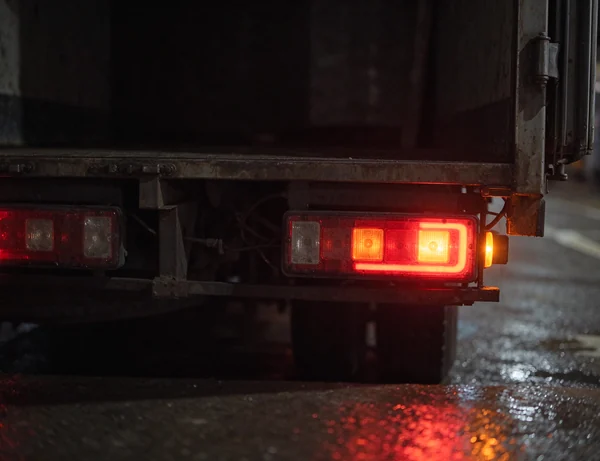
Rear of a truck at night with the right tail lamp lit and the left one dark, on a wet yard surface

One side out, one side working. That pattern is a ground or a side feed, not a bulb.

1. Start with the lamp housing, not the fuse box

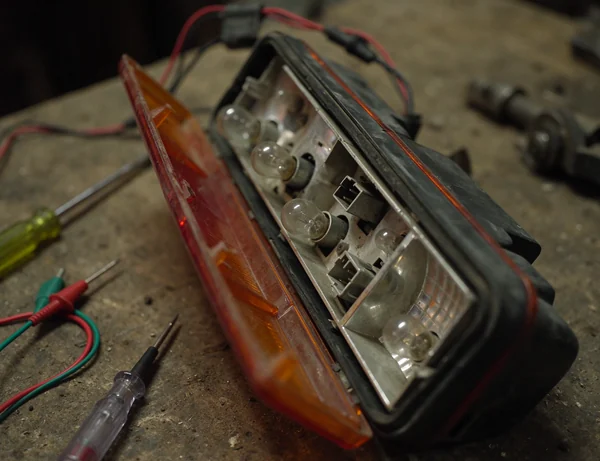
  1. Open the lamp and look at the holders. Corrosion in a bayonet holder, a melted socket, or a bulb that has been fitted with the wrong wattage are all visible and all common. A socket that has overheated because of a poor contact will fail again with a new bulb.
  2. Check the earth inside the housing. Most multi-function lamps earth through the housing or through a single wire. That single point is the usual cause of a lamp that glows dimly or lights the wrong filament.
  3. Flex the loom at the lamp. Grab the harness and gently move it while a helper watches the lamp. A lamp that flickers is a broken strand or a chafed wire at the connector, and it will fail completely on a rough road.
  4. Then go to the fuse and relay. Only after the lamp itself is proven good. A fuse that blows repeatedly is reporting a short, not asking for a bigger fuse.
Removed truck tail lamp assembly with bulbs and a corroded socket visible on a workshop bench

Corroded socket with bulbs removed. This is where most “one lamp out” faults actually live.

2. Trailer circuits, the part that gets blamed for everything

Symptom Most likely cause Test
Trailer lamps dead, tractor fine Trailer socket corrosion, damaged cable, or a blown trailer fuse Test at the socket with a load, not a meter alone
Trailer brake lamps dead, tail lamps fine Separate feed for the brake circuit at the socket Check each pin at the socket individually
Lamps flash when the indicator is on Shared earth with a poor connection Measure voltage at the earth pin while the indicator is on
Everything works until the truck is loaded Vibration opening a worn connector Flex the loom and the socket with the lamps on
Never fit a larger fuse to stop it blowing. The fuse is sized for the wire, not for the lamp. A larger fuse lets the wire overheat and turns a lighting fault into a fire or a burnt harness, and the original fault is still there.
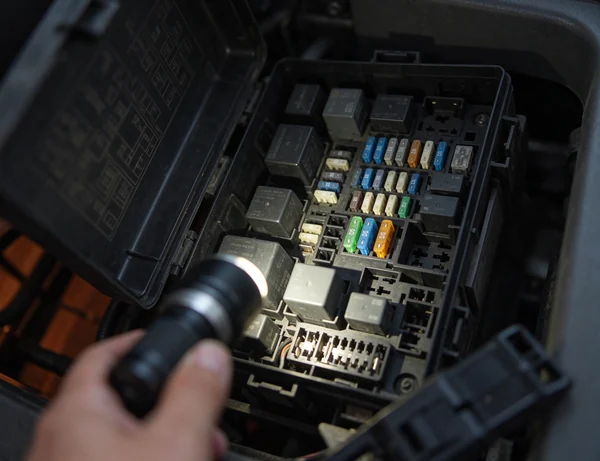
Blade fuses and relays in the cab fuse box of a HOWO T5G checked with a torch

Cab fuse box. Check the holder as well as the fuse — a corroded holder reads open with a good fuse.

3. Why a new bulb does not fix it

Because the bulb was never the fault. Three situations repeat constantly: a holder that has lost its spring tension so the bulb sits loose and arcs; a housing earth that has corroded, so the lamp finds a return path through another filament and glows dimly; and a connector pin that has backed out of its housing, which looks connected and is not. In all three, a fresh bulb works for a day and then the complaint returns.

4. Questions drivers ask most

Why does one indicator flash fast?
Because the flasher unit sees less load on that side — normally a failed bulb, or a poor contact adding resistance. Fix the lamp, not the flasher.
Can a bad earth cause several lamps to misbehave at once?
Yes, and that is the classic signature. Lamps find return paths through each other, so pressing the brake can light the indicator dimly. Always suspect the earth when functions interact.
Is it worth fitting LED lamps?
Only with lamps designed for the truck’s voltage and with a compatible flasher. LEDs draw less current, and on some older flasher units that is read as a failed bulb, giving you a fast flash that never goes away.
Why do lamps fail after rain?
Water in the housing. A lamp with a cracked lens or a missing seal fills with condensation, and the corroded holder fails weeks later. Replace the housing, not just the bulb.
Need tail lamps, lamp housings, flasher units, fuses or trailer sockets for your T5G? Send the chassis number and we will confirm the correct lamps for your build. Send your request

Lamp wattages, fuse ratings and connector pin-outs are model-specific. Confirm them in the OEM wiring diagram and never substitute a higher-rated fuse for the specified one.

Need Help or Want More Detailed Maintenance Information?

Please contact our team for personalized maintenance guidance and technical support for your Sinotruk HOWO, A7, or T7 trucks. We provide professional advice and recommendations for genuine parts to help ensure the reliable operation of your fleet.

Contact Us
More Articles

Howo Sinotruk Parts & Catalog PDF

Whenever your truck needs repair, you don’t know how to buy the right parts?

Don’t worry, we have already done this job for you. We have a complete parts list catalog for different models of each truck assembly, you can choose the right catalog to download and collect according to your truck configuration.

When you have a need, you can send us your required list based on this catalog.

Obtain the complete Howo truck parts catalog PDF file and pricing.

Contact Us
Hot-Selling Replacement Parts

whatsapp-4