banner-news1
REPAIR FAQ
Back

SITRAK C9H CAN Bus Faults: Symptoms and a Practical Test Order

Short answer: communication faults on a SITRAK C9H usually start at a connector, not at a module. Before you replace anything electronic, measure the bus itself: resistance across the pair should read a stable value with the ignition off, and the two signal wires should show a clean differential when powered. A bus that reads open or shorted has a wiring fault; a bus that measures correctly but still drops nodes has a module or a termination problem. That sequence stops you buying a controller to fix a chafed wire.

CAN faults feel intimidating because the symptoms are strange — a truck that will not crank, a gearbox that will not shift, a cluster that goes blank and comes back. All of those can come from one broken wire, and all of them recover when the wire is repaired.
QUICK DIAGNOSIS — what the failure pattern says
  1. 1One module offline, everything else fine — that module’s power, earth or connector.
  2. 2Several modules offline at once — the bus pair, a shared earth, or a termination.
  3. 3Faults appear only when wet or over bumps — water in a connector or a chafed harness at a frame edge.
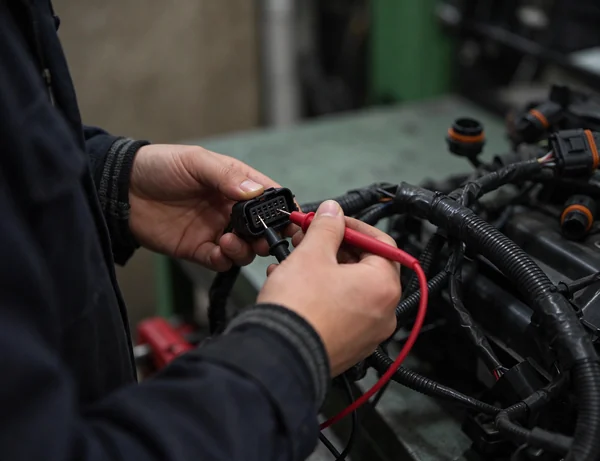
Technician probing the pins of a harness connector with a multimeter on a SITRAK C9H

Probe the connector, not the module. Most bus faults are at a pin, a crimp or a chafed wire.

1. Measure the bus before replacing anything

  1. Ignition off, battery disconnected. Measure resistance across the two signal wires at the diagnostic connector. You are looking for the termination resistance of the network — a stable value, not zero and not open. Zero means a short; open means a broken wire or a missing termination.
  2. Reconnect and measure with the ignition on. Both wires should sit at defined levels that change slightly as traffic flows. A wire stuck at one level, or a wire at battery voltage, points to a short to power or to ground.
  3. Wiggle the harness while watching the meter. A reading that jumps when you flex the loom is the fault, and you have found it without replacing a single component.
  4. Isolate by disconnecting nodes one at a time. If the fault clears when a particular module is unplugged, the module or its wiring is dragging the bus down. Do this with the ignition off, one node at a time.
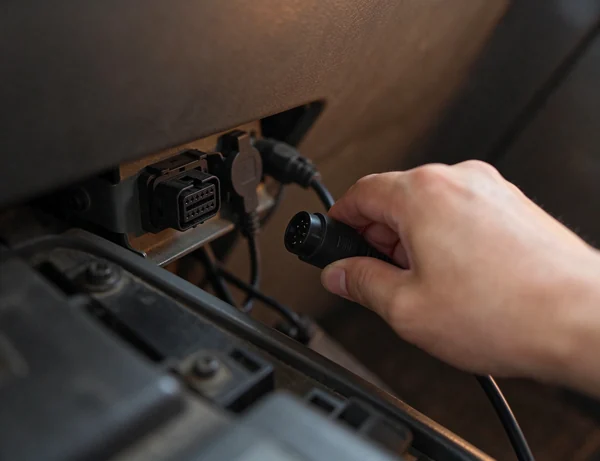
Diagnostic socket in the cab of a SITRAK C9H with a scan tool connector ready to plug in

Diagnostic socket. Testing here proves the bus before the tool blames a module.

2. Connections fail far more often than modules

Location Typical fault What you will see
Chassis-to-cab connector Water ingress, corroded pins, loose barrel Faults after rain, or after a cab tilt
Harness at frame edge Chafe through the insulation Faults over bumps, worse when loaded
Module connector Backed-out pin, damaged crimp One node offline, returns when the plug is pressed
Shared earth point Corrosion, loose bolt Several modules offline together
Termination resistor Missing or damaged after a repair Network unstable, intermittent on every node
Do not probe a live bus with a test lamp. A test lamp draws far more current than a signal wire is designed for, and probing the wrong pin can destroy a module output. Use a meter with high impedance, and check the pin-out in the wiring diagram before touching anything.
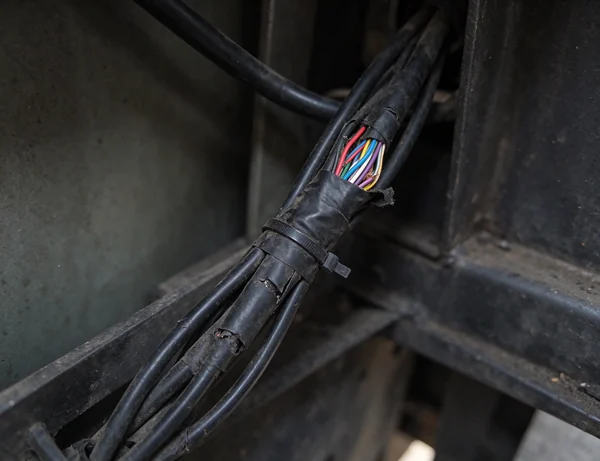
Chafed wiring harness on a truck frame with exposed conductors and a repair wrap

Chafe at a frame edge. The insulation is worn through and the fault only shows when the loom moves.

3. Symptoms people misdiagnose

A truck that will not crank is often blamed on the starter, when the immobiliser module simply is not being heard on the bus. A gearbox that will not select is often blamed on the gearbox, when the transmission controller has lost its counterpart. A cluster that blanks and recovers is nearly always a supply or earth issue at the cluster connector. In all three cases, the module that “failed” is the module that noticed — the fault is somewhere else.

4. Questions drivers ask most

Will clearing the codes fix it?
No. Clearing codes removes the record of the fault, not the fault. If a code returns immediately after clearing, the condition is present right now and must be diagnosed.
Can a low battery cause bus faults?
Yes. Low voltage makes modules drop off and log communication errors that are entirely false. Always confirm the battery and the charging system before chasing the network.
Why does the fault go away when I unplug and replug a module?
Because the fault is at the connector, and replugging wipes the corrosion or reseats a backed-out pin. That behaviour is a strong sign to inspect and repair the connector properly rather than to keep replugging it.
Is a corroded connector repairable?
Often yes: clean the pins, replace the terminal if it is pitted, and seal the connector. Replace the connector when the housing is cracked or a pin seat is damaged, because cleaning cannot restore a broken seat.
Need harness connectors, sensors, a transmission controller or a diagnostic socket for your C9H? Send the chassis number and the fault description and we will confirm the correct parts. Send your request

Bus topology, termination values and pin-outs differ by build. Use the OEM wiring diagram for your chassis and never probe a live network with a test lamp.

Need Help or Want More Detailed Maintenance Information?

Please contact our team for personalized maintenance guidance and technical support for your Sinotruk HOWO, A7, or T7 trucks. We provide professional advice and recommendations for genuine parts to help ensure the reliable operation of your fleet.

Contact Us
More Articles

Howo Sinotruk Parts & Catalog PDF

Whenever your truck needs repair, you don’t know how to buy the right parts?

Don’t worry, we have already done this job for you. We have a complete parts list catalog for different models of each truck assembly, you can choose the right catalog to download and collect according to your truck configuration.

When you have a need, you can send us your required list based on this catalog.

Obtain the complete Howo truck parts catalog PDF file and pricing.

Contact Us
Hot-Selling Replacement Parts

whatsapp-4