banner-news1
REPAIR FAQ
Back

HOWO TX MAX Broken Leaf Spring and Loose U-Bolt Checks

Short answer: a broken leaf on a Sinotruk truck almost never breaks first and explains itself afterwards — it breaks because something else moved. Before fitting a new spring, check the U-bolts and their torque, the centre bolt, the spring clips, the shackle bushes and the load distribution. A new spring fitted onto a worn centre bolt or a loose U-bolt will break again, often within a few thousand kilometres, and the driver will blame the spring.

Springs carry load and absorb shock, and they do it while being clamped, twisted and bent by every bump. The fatigue life is set by the clamping quality and by how evenly the load is shared between the wheels and the axles. When one of those goes wrong, the spring becomes the fuse that blows.
QUICK DIAGNOSIS — what a broken spring feels like before you see it
  1. 1Truck leans to one side, worse when loaded — a leaf has cracked, often at the centre or in the second leaf.
  2. 2Clunk on bumps and a wandering rear axle — loose U-bolts or a broken centre bolt, so the axle is moving on the spring.
  3. 3Tyre wear on one side of the axle — the axle is no longer square to the chassis because the spring has shifted.
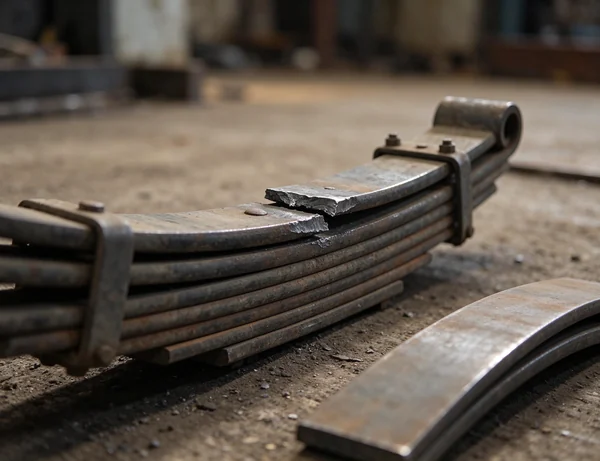
Broken leaf spring assembly from a heavy truck laid beside a new spring on a workshop floor

Broken spring beside a new one. Look at where it broke — the location tells you what caused it.

1. Before you fit the new spring

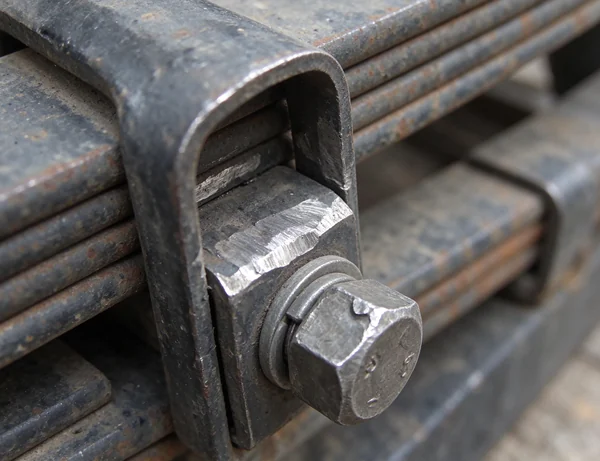
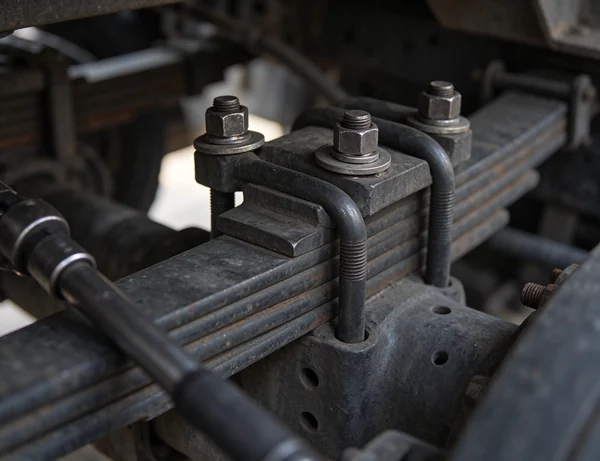
  1. Check the U-bolts and their torque. Loose U-bolts let the spring and axle move independently, which reverses the stress in the leaf every cycle. They are also a safety item: a U-bolt that fails releases the axle.
  2. Inspect the centre bolt and the saddle. A worn saddle or a stretched centre bolt lets the leaves slide, and the spring loses its rated stiffness. Replace both with the spring.
  3. Check the shackle bushes and pins. Worn bushes add movement that the spring was never designed to absorb, and they also make the steering feel vague on a front axle.
  4. Check the spring clips and the bump stops. A missing clip lets the leaves separate and work independently, which overloads the main leaf. A worn bump stop allows over-travel that the spring cannot survive.
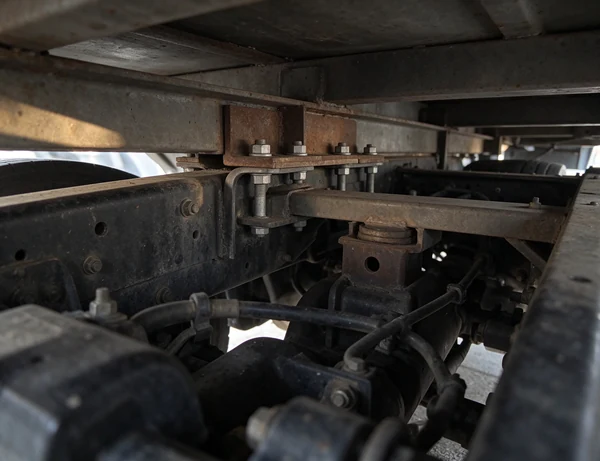
Rear axle U-bolts and spring saddle on a truck chassis with movement marks visible around the clamp

U-bolts and saddle. Fretting marks around the clamp mean the axle has been moving on the spring.

2. Why springs break, in order of frequency

Cause Where it breaks Prevention
Overloading Main leaf, near the centre Respect the axle rating; check load distribution
Loose or worn U-bolts At the saddle, with fretting marks Correct torque at every service; replace stretched bolts
Worn centre bolt Centre, leaves shifted sideways Replace with each spring; never reuse
Missing spring clips Outer leaves, at the ends Refit clips; they are cheap and they matter
Corrosion and cracked paint Between leaves, at the contact points Inspect and lubricate between leaves where specified
Never fit a spring with reused U-bolts that show stretch or thread damage, and never mix springs of different rates on the same axle. An axle with one stiff and one tired spring shares the load unevenly, and the stiffer side then carries more than its rating. Both sides are replaced as a pair when the rates differ.
Spring clip and centre bolt on a truck leaf spring with displacement wear marks

Clip and centre bolt with wear marks. Movement here is what cracks the leaf beside it.

3. Loading practice that makes springs last

Two habits dominate spring life. The first is even load distribution: a load concentrated at the rear of the bed puts most of its weight on the rear axle and its springs, and the front springs then unload and the truck pitches. The second is avoiding shock loading — dropping a load onto the bed, or driving a loaded truck over kerbs and un-made roads, produces stress spikes far above the static rating. Springs are designed for fatigue over millions of cycles, not for a handful of impacts.

4. Questions drivers ask most

Can I drive with one broken leaf?
Only to a safe place at reduced load. A broken leaf reduces the axle’s capacity and the axle can shift, which affects braking and steer. It is not a condition to keep working in.
Why did the new spring break so quickly?
Almost always because the cause was not corrected — a worn centre bolt, loose U-bolts or a missing clip. The spring was the symptom, not the fault.
Should the spring be re-tempered or replaced?
Replace. Re-tempering a fatigue-cracked leaf does not restore its life, and a cracked leaf can fail without warning.
Does overloading break springs or axles first?
It depends on the design margin, and the answer does not matter much: both are safety-critical. An overloaded truck is outside its rated capacity wherever the failure appears.
Need leaf springs, U-bolts, centre bolts, clips or shackle bushes for your Sinotruk truck? Send the chassis number and axle rating and we will confirm the correct spring rate. Send your request

Spring rates, U-bolt torque figures and axle ratings are build-specific. Confirm them in the OEM manual, and treat any suspension repair as safety-critical work.

Need Help or Want More Detailed Maintenance Information?

Please contact our team for personalized maintenance guidance and technical support for your Sinotruk HOWO, A7, or T7 trucks. We provide professional advice and recommendations for genuine parts to help ensure the reliable operation of your fleet.

Contact Us
More Articles

Howo Sinotruk Parts & Catalog PDF

Whenever your truck needs repair, you don’t know how to buy the right parts?

Don’t worry, we have already done this job for you. We have a complete parts list catalog for different models of each truck assembly, you can choose the right catalog to download and collect according to your truck configuration.

When you have a need, you can send us your required list based on this catalog.

Obtain the complete Howo truck parts catalog PDF file and pricing.

Contact Us
Hot-Selling Replacement Parts

whatsapp-4