

Short answer: Turbo surge sounds like a rapid fluttering from the air intake under load, and it is usually a boost control fault rather than a worn turbo. The wastegate or the VGT vanes are being told the wrong thing, or the actuator cannot follow the command, so boost climbs past what the engine can use and the compressor stalls back into the intake. Measure commanded against actual boost before anything is removed.
Two faults produce the same noise: an over-boost condition from a stuck wastegate or VGT, and an air restriction that makes the compressor work against a vacuum. The first is a control fault, the second is an intake or filter fault.
Both are cheap to identify with live data and a restriction gauge, and expensive to identify by replacing the turbo.
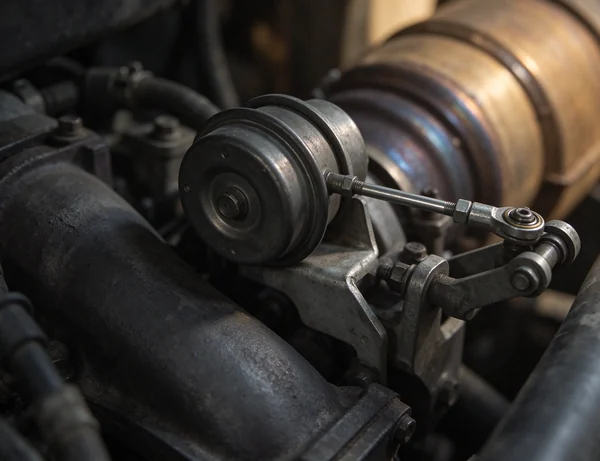
Log commanded boost and actual boost at steady loads. Surge appears where actual exceeds commanded by a clear margin and then drops sharply as the compressor stalls. A shortfall across the range is a leak or a restriction instead.
Then command the actuator with the diagnostic tool and watch the rod or the vane position. No movement means the fault is in the actuator, the linkage or its air supply, and the turbo cartridge is innocent.
Wastegate linkages seize from carbon and heat. VGT vanes seize from soot in the turbine side, especially on engines doing short runs where the vanes never exercise fully.
On a VGT, a calibration routine that cannot complete is often the first sign. The actuator reports a position it cannot reach, and the ECU limits boost to protect the engine, which the driver feels as a flat spot rather than a surge.
| Symptom | Cause | Action |
|---|---|---|
| Surge at one load point, boost over target | Wastegate held shut | Free or replace the actuator |
| Flat response, boost under target | VGT vanes seized or actuator limited | Clean or replace the turbo |
| Whistle plus low boost | Boost hose split or intercooler leak | Pressure test the charge system |
| Surge only with a dirty filter | Intake restriction | Replace filter, check the pipe |
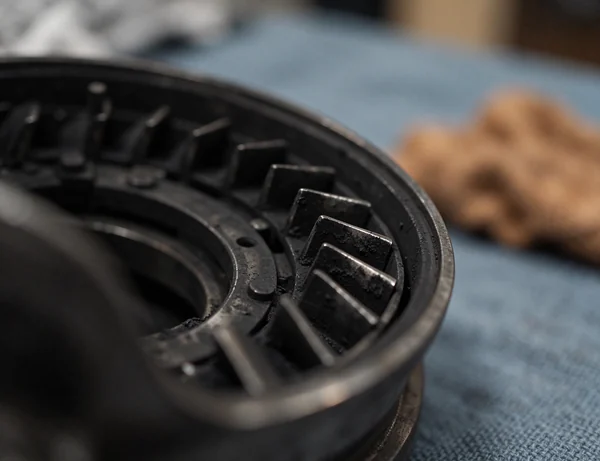
Confirm three things: the actuator moves when commanded, the charge system holds pressure when tested, and the intake is not restricted. A turbo replaced without these checks is often a second turbo replaced for the same fault.
After any turbo work, run a regeneration-friendly duty cycle for the first week. Short stop-start work is what soots a new VGT and starts the cycle again.

Boost limits, actuator calibration and turbo part numbers are engine specific. Confirm them in the OEM manual.
Please contact our team for personalized maintenance guidance and technical support for your Sinotruk HOWO, A7, or T7 trucks. We provide professional advice and recommendations for genuine parts to help ensure the reliable operation of your fleet.
Contact Us

Whenever your truck needs repair, you don’t know how to buy the right parts?
Don’t worry, we have already done this job for you. We have a complete parts list catalog for different models of each truck assembly, you can choose the right catalog to download and collect according to your truck configuration.
When you have a need, you can send us your required list based on this catalog.
Obtain the complete Howo truck parts catalog PDF file and pricing.
Contact Us
2001-2026 Shandong Yimo Auto Sales Co., Ltd. © All rights reserved.


