

Short answer: Crankcase pressure on a Sinotruk six cylinder engine comes from blow-by past the rings, and the engine has a breather to keep that pressure harmless. When the breather clogs, the pressure finds its own exits: the dipstick, the oil filler, the rear main seal and the rocker cover gasket. Test the breather before you measure the rings, because a blocked breather is a ten minute fix and a ring job is not.
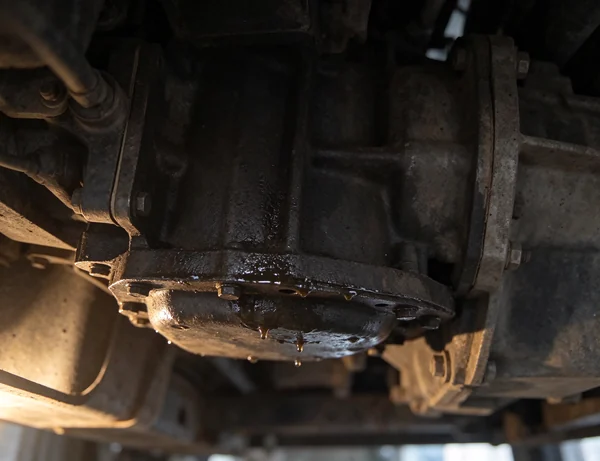
The first sign is usually a rear main seal that starts to weep, followed by an oil mist creeping over the bell housing. A mechanic replaces the seal, the leak returns within weeks, and the seal gets the blame for a fault that lives inside the engine.
Blow-by is normal in small quantities. The question is whether the engine is producing more than the breather can handle, and whether the mist carries oil that the separator should be catching.
With the engine idling warm, remove the oil filler cap and place a sheet of paper over the opening. A slight flutter is normal. A steady push that lifts the paper, or a rhythmic pulse that matches one cylinder, is pressure that the breather is not releasing.
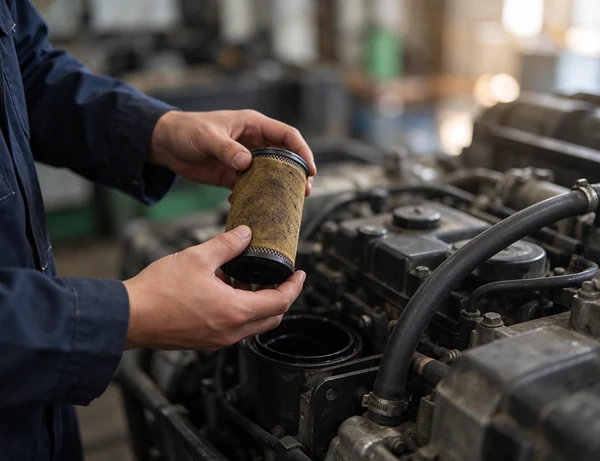
Then check the breather itself: the filter element, the hose for internal collapse, and the separator if the engine is fitted with one. A hose that has softened and flattened under heat restricts flow exactly like a blocked filter, and it is not visible until it is in your hand.
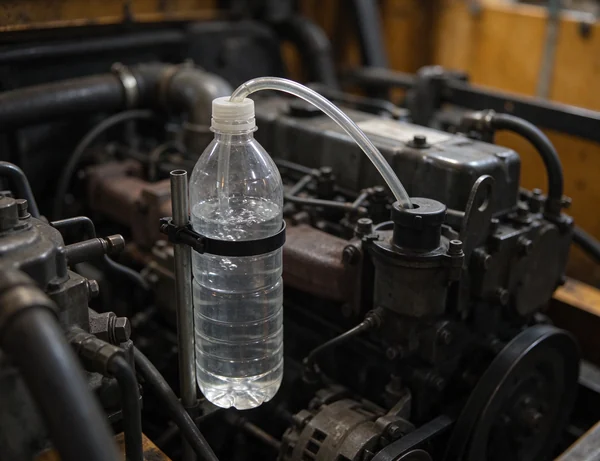
Blow-by is measured with a flow meter or a water column on the breather outlet, and the result is compared with the limit in the manual. A water column is the simpler field method: a clear tube in a bottle of water, connected to the breather, shows the pressure in centimetres of water at idle and at rated speed.
The reading has to be taken with the engine warm and the breather disconnected at the outlet, otherwise you are measuring the restriction rather than the source. Record both speeds, because worn rings show a large difference between idle and full load.
| Test | Normal | Suspect |
|---|---|---|
| Filler cap flutter at idle | Light, irregular | Strong, rhythmic with one cylinder |
| Water column at idle | Low and steady | High or pulsing |
| Water column at rated speed | Rises but stays within limit | Rises far above the limit |
| Oil mist in the breather outlet | Slight | Heavy, with droplets |
If blow-by exceeds the limit with the breather clear, the next check is compression and leak-down on all six cylinders. A single cylinder with high leak-down points at that piston, ring pack or liner; an even rise across all six points at general wear.
Before you accept general wear, rule out two cheaper causes: an overfilled sump that lets the crankshaft whip oil into mist, and a turbo or air compressor passing oil into the intake, which looks like blow-by but is not.
Blow-by limits and breather specifications vary by engine variant. Use the OEM figures for your engine number.
Please contact our team for personalized maintenance guidance and technical support for your Sinotruk HOWO, A7, or T7 trucks. We provide professional advice and recommendations for genuine parts to help ensure the reliable operation of your fleet.
Contact Us

Whenever your truck needs repair, you don’t know how to buy the right parts?
Don’t worry, we have already done this job for you. We have a complete parts list catalog for different models of each truck assembly, you can choose the right catalog to download and collect according to your truck configuration.
When you have a need, you can send us your required list based on this catalog.
Obtain the complete Howo truck parts catalog PDF file and pricing.
Contact Us
2001-2026 Shandong Yimo Auto Sales Co., Ltd. © All rights reserved.


