

Short answer: Exhaust backpressure is the pressure the engine has to push against to empty its cylinders. A crushed pipe, a collapsed internal baffle or a blocked DPF raises it, and the symptoms are a power loss at load, high exhaust temperature and a turbo that looks lazy. The measurement takes a gauge and a test port, and it separates an exhaust restriction from a turbo problem in a few minutes.
On a turbocharged engine, backpressure is measured between the manifold and the turbine inlet, where the pressure is highest. A gauge fitted at the test port reads directly what the turbo and the pistons have to overcome.
Because the restriction is downstream, the turbo can look healthy and still be blamed: it is spinning, it makes boost, and the engine still will not pull. The restriction shows in the temperature and the backpressure numbers.
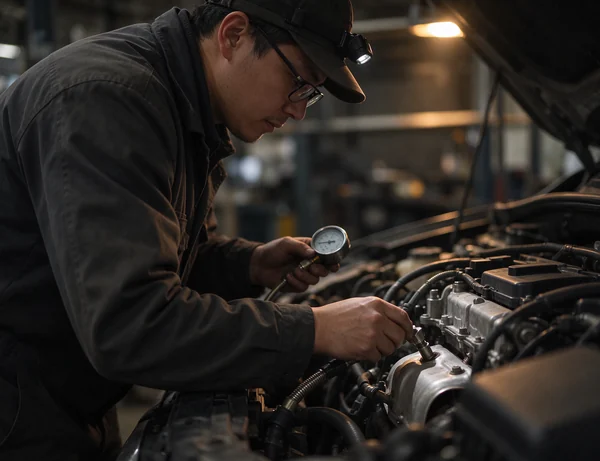
Fit a pressure gauge to the exhaust test port at the manifold or the turbine inlet, according to the OEM location. Run the engine at rated speed and record the value, then compare it with the limit for your engine.
A rising value that exceeds the limit at rated speed is a restriction. A value that is normal at low speed and excessive only at high speed points to a component that cannot flow, usually the muffler.
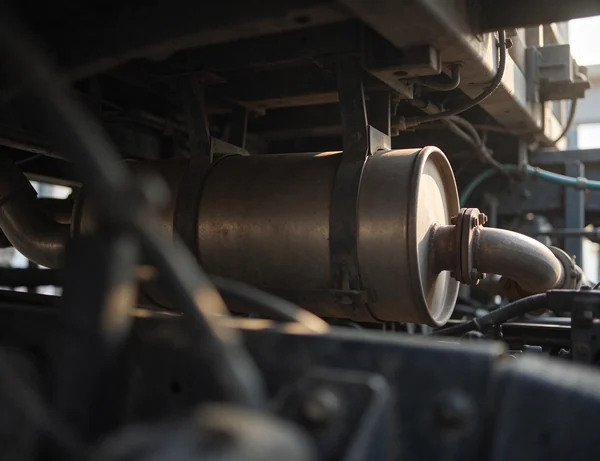
The muffler is the most common single item. Its internal baffles collapse with age and heat, and the outside looks normal. A muffler that rattles when struck or that has an unusual exhaust note is suspect.
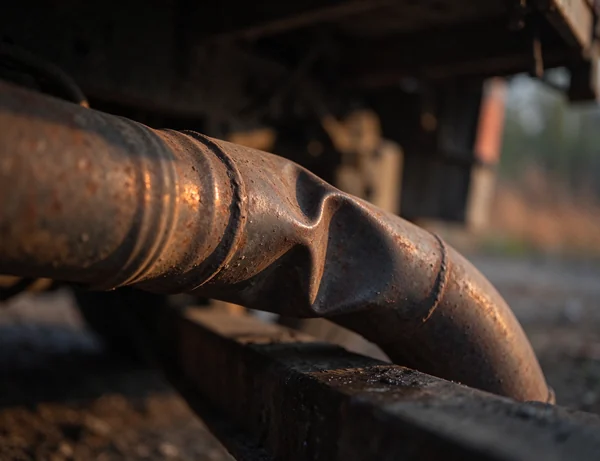
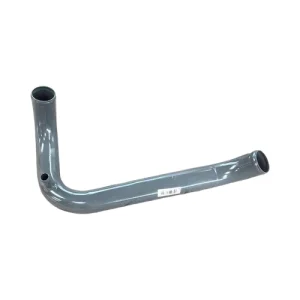
Flexible sections and bends collapse internally, and a DPF that has been overloaded with soot behaves as a restriction even when its sensor is healthy.
| Component | Check | Correct action |
|---|---|---|
| Muffler | Note change, rattle, backpressure above limit | Replace the muffler |
| Pipe run | Dents, crushed sections, internal collapse | Replace the section |
| DPF | Differential pressure, regeneration history | Clean or replace the filter |
| Turbo turbine side | Soot build up, vane condition | Clean or replace the turbo |
Re-measure backpressure at rated speed and confirm it is within the limit. Then check the exhaust temperature at load, which should return to normal once the restriction is removed.
If the fault was caused by a DPF that had been overloaded, review the duty cycle and the regeneration history. A truck doing short runs will block a filter again unless the regeneration opportunities are managed.
Backpressure limits and test port locations are engine specific. Confirm them in the OEM manual.
Please contact our team for personalized maintenance guidance and technical support for your Sinotruk HOWO, A7, or T7 trucks. We provide professional advice and recommendations for genuine parts to help ensure the reliable operation of your fleet.
Contact Us
Whenever your truck needs repair, you don’t know how to buy the right parts?
Don’t worry, we have already done this job for you. We have a complete parts list catalog for different models of each truck assembly, you can choose the right catalog to download and collect according to your truck configuration.
When you have a need, you can send us your required list based on this catalog.
Obtain the complete Howo truck parts catalog PDF file and pricing.
Contact Us
2001-2026 Shandong Yimo Auto Sales Co., Ltd. © All rights reserved.


