banner-news1
REPAIR FAQ
Back

HOWO T5G Belt Squeal and Tensioner Wear: Reading the Symptoms

Short answer: a belt that squeals for the first minute from cold and then goes quiet on a HOWO T5G is usually not a worn belt — it is a tensioner that has lost its spring preload, or a pulley that has gone out of alignment. Replacing the belt alone gives you a quiet truck for two weeks and then the squeal comes back, because the belt was the symptom and the tensioner was the cause. Before buying anything, check the tensioner pointer against the wear marks, spin every pulley by hand, and look at the belt tracking from the front with the engine idling.

Serpentine accessory drives on these engines carry the alternator, the fan, the air compressor and the steering pump on one belt. That means one weak tensioner affects every accessory at once, and one misaligned pulley scrubs a belt across its whole width instead of a single rib.
QUICK DIAGNOSIS — the squeal has a shape
  1. 1Cold squeal that disappears when warm — tensioner spring tired, or a belt that has hardened with age.
  2. 2Squeal on start-up and after every hard acceleration — belt slipping under load. Tension, pulley alignment, or a seized accessory.
  3. 3Chirp once per belt revolution — a damaged rib or a stone embedded in a pulley groove.
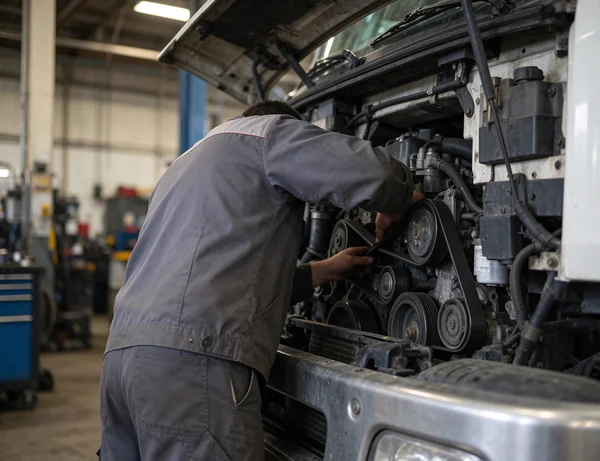
Technician inspecting the accessory belt drive at the front of a HOWO T5G engine in a workshop

Look at the belt from the front with the engine idling. Tracking tells you more than the noise does.

1. The tensioner pointer is the free test

  1. Run the engine briefly and stop it. Watch the tensioner arm settle. A healthy tensioner returns to its mark and stays there.
  2. Compare the pointer with the wear range. Most tensioners have a marked band; if the pointer is at the end of the band, the spring has taken a set and the belt is running slack even when it looks tight.
  3. Push the arm by hand and release it. It should move against strong spring pressure and return crisply. An arm that moves easily, or creeps back slowly, is finished.
  4. Listen at the tensioner bearing. With the engine off, spin the idler by hand and feel for roughness. A dry idler bearing makes a squeak that everyone blames on the belt.
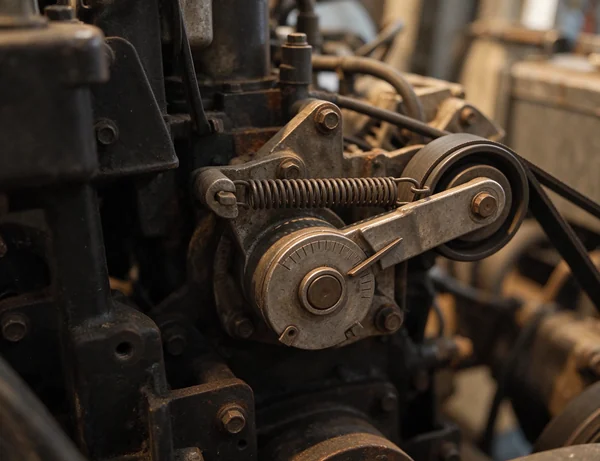
Belt tensioner with its pointer and wear marks on a HOWO T5G engine

Pointer at the end of the wear band means the belt is slack whatever it feels like by hand.

2. Read the belt itself

What the belt shows Meaning Action
Glazed, shiny ribs Slipping, usually tension or a seized accessory Replace belt, fix the cause, re-check tension
Ribs worn down to the cords Long-term misalignment or a worn pulley Inspect pulley faces for grooves or rust
Cracks across the ribs Age and heat Replace belt; check for a heat source nearby
One edge frayed Misalignment — a pulley is out of plane Check every pulley with a straight edge
Transverse breaks in a short section Instant overload — a seized pulley Find and free the seized component before refitting
Do not apply belt dressing to silence a squeal. Dressing temporarily restores grip and hides the fault while the belt slips under load. On an accessory drive that also runs the fan and the alternator, a slipping belt means reduced charging and reduced cooling, and the failure arrives at the worst possible moment.
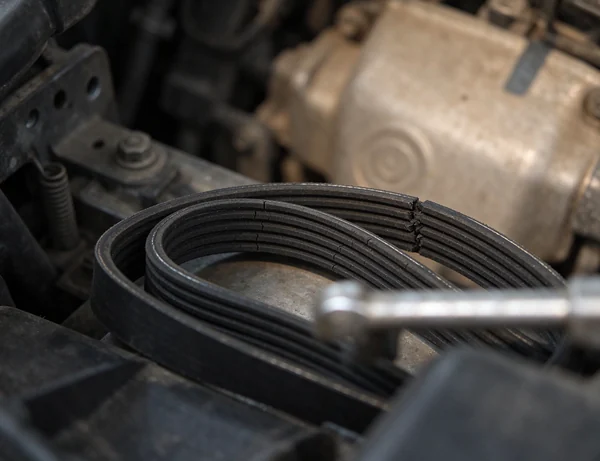
Serpentine accessory belt removed from a HOWO T5G showing transverse cracks and rib wear

Cracks across the ribs are age, not load. Replace it and check what took the tension out.

3. Alignment, the fault nobody checks

Hold a straight edge across two pulleys that share a belt and look at the gap at the third. A pulley that is out of plane by even a small amount pulls the belt against one wall of a groove, and that wall wears the belt edge away. Common causes are a worn tensioner pivot, a bracket that has cracked, or an alternator that has been replaced with one whose pulley offset differs from the original.

4. Questions drivers ask most

Can I just tighten the belt?
On a spring tensioner there is nothing to tighten — the spring sets the tension. If the belt is slack, the tensioner has failed. Forcing extra tension by shimming overloads the bearings of every accessory on the drive.
Why does the squeal come back after a new belt?
Because the belt was replaced and the tensioner or the alignment fault was not. A new belt is slightly thicker and holds tension for a while, then the same weak spring lets it slip again.
Does a squealing belt affect the battery?
Yes. A slipping belt turns the alternator slower than it should, so charging falls off exactly when the truck needs it most — at idle with lights and air conditioning on.
Should I replace the tensioner and belt together?
Usually yes. They wear as a pair, and a new tensioner against a glazed old belt will slip while a new belt against a tired tensioner will squeal. Doing both once is cheaper than doing each of them twice.
Need a belt, tensioner, idler pulley or the correct drive belt routing for your T5G? Send the engine number and we will confirm the correct belt length and tensioner variant. Send your request

Belt lengths, routing and tensioner part numbers vary by engine variant and accessory layout. Confirm them in the OEM parts catalogue before ordering.

Need Help or Want More Detailed Maintenance Information?

Please contact our team for personalized maintenance guidance and technical support for your Sinotruk HOWO, A7, or T7 trucks. We provide professional advice and recommendations for genuine parts to help ensure the reliable operation of your fleet.

Contact Us

More Articles

Howo Sinotruk Parts & Catalog PDF

Whenever your truck needs repair, you don’t know how to buy the right parts?

Don’t worry, we have already done this job for you. We have a complete parts list catalog for different models of each truck assembly, you can choose the right catalog to download and collect according to your truck configuration.

When you have a need, you can send us your required list based on this catalog.

Obtain the complete Howo truck parts catalog PDF file and pricing.

Contact Us
Hot-Selling Replacement Parts

whatsapp-4