banner-news1
REPAIR FAQ
Back

HOWO T5G Front Wheel Shimmy and Tyre Wear: A 6-Point Check

Short answer: front wheel shimmy on a HOWO T5G has two different speeds and two different causes. A shake that starts around 60–70 km/h and grows with road speed is a rotating assembly out of balance — tyre, rim or hub run-out. A shake that appears at 90 km/h and can be felt through the steering wheel and heard as a clonk is play in the linkage, the wheel bearings or the kingpins. Check the speed band first, because balancing a wheel will never cure a worn kingpin, and replacing a kingpin will never cure an out-of-round tyre.

Front-end wear on a distribution or short-haul T5G is accelerated by constant full-lock manoeuvring, kerb strikes and a loaded front axle. Tyre cupping and shoulder scrub are the visible record of that wear, and reading the wear pattern usually tells you the fault before you put a gauge on anything.
QUICK DIAGNOSIS — match the speed to the fault
  1. 1Shake from 60 km/h, worsens with speed, disappears when you slow down — balance, run-out or a tyre with an internal fault.
  2. 2Shake around 90 km/h with a clonk, no change with balance — play in linkage, bearings, kingpins or the steering gear.
  3. 3Shake only under braking — disc or drum run-out and a warped or heat-cracked friction surface.
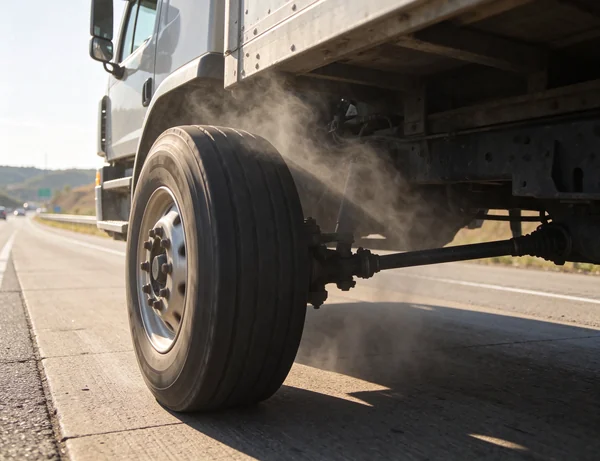
HOWO T5G front wheel and steering linkage photographed from the emergency lane after a shimmy complaint

Note the speed band the driver reports. It is the single most useful fact in this diagnosis.

1. Six checks, in the order that saves money

  1. Tyre condition and pressure. Measure cold. A tyre run low on pressure is more prone to cupping and to standing-wave behaviour at speed. Look for a bulge in the tread or sidewall — an internal casing fault can produce a shimmy that looks exactly like a balance problem.
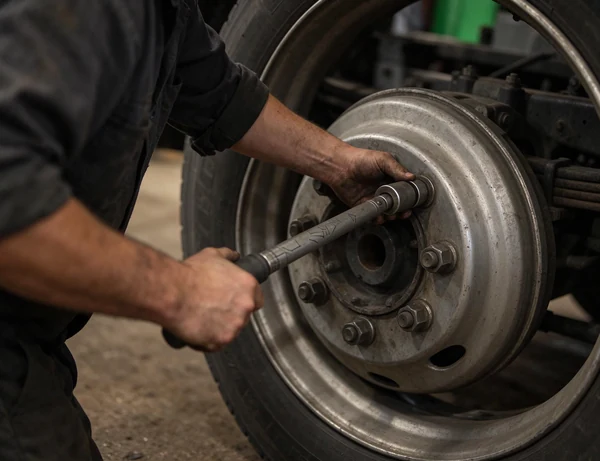
  2. Wheel and hub run-out. Jack the axle, spin the wheel and watch a dial gauge or a fixed pointer against the rim lip and the tyre tread. Run-out beyond the manual limit means the rim, the tyre or the hub face is the problem, and balancing will not correct it.
  3. Balance. Static and dynamic balance on the front wheels. A front tyre that needed a large correction weight is a candidate for the shimmy, and the weights themselves are worth checking — a weight that has flown off is the cheapest possible find.
  4. Wheel bearing play. With the wheel off the ground, rock it top to bottom and side to side. Vertical play is bearing; horizontal play is steering linkage. Both can be present at once.
  5. Kingpin and linkage play. Bar each joint with a pry bar while a helper watches. Drag link, tie rod ends and the steering gear input all need checking, because play anywhere in the chain reaches the steering wheel as a shake.
  6. Steering gear and damper. Check for a worn damper or a gear with excessive free play at the input. A damper that has lost its oil lets every road input through to the wheel.
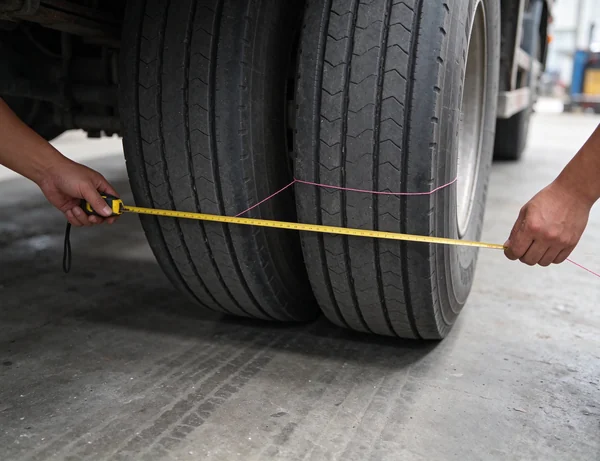
Measuring front toe on a HOWO T5G with a tape measure and chalk line between the two front wheels

Measuring toe with a tape and a chalk line. A visible error here explains both the shimmy and the scrub pattern.

2. Reading the tyre wear pattern

Wear pattern Cause What it means for the shimmy
Cupping or scalloped spots around the tread Worn shock absorber, or a wheel bouncing because of balance Replace the damper and rebalance, then re-check
Feathered tread, one direction only Excessive toe Align before anything else; the shimmy may disappear with the geometry
Shoulder scrub on one side only Camber or a bent spindle Check for impact damage on that side
Flat spot or a bulge Casing fault, or a locked brake that flat-spotted the tyre The tyre is the fault; balancing cannot help
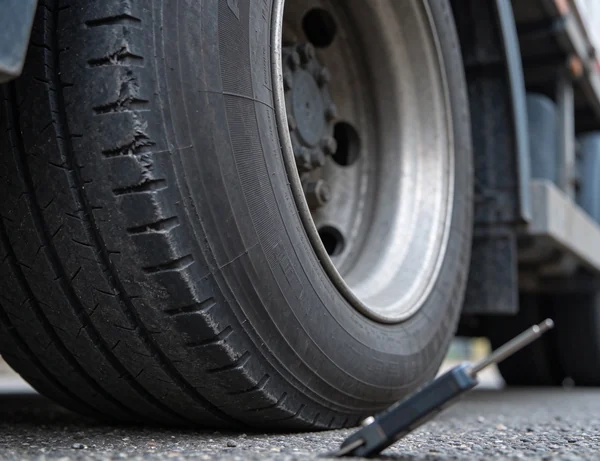
Front tyre of a HOWO T5G showing scalloped shoulder wear measured with a tread depth gauge

Cupping like this is a bouncing wheel, not a bad tyre. Find the damper and the balance fault behind it.
Do not chase a shimmy by swapping parts. Every part in the front end can produce a shake, so fitting a new damper, then a new tyre, then a new bearing proves nothing except which part you happened to fit last. Measure run-out, measure play, and only then replace.

3. What balancing cannot fix

Balance corrects mass distribution around the wheel. It cannot correct a rim that is out of round, a tyre with a casing defect, a hub face that is not square to the axle, or any looseness in the assembly. If a wheel needed a large weight and the shimmy persists afterwards, the next measurement is run-out — and if run-out is within limits, the next suspect is a tyre that has taken a set from standing or from a locked brake.

4. Questions drivers ask most

Why does it stop when I brake gently?
Because braking loads the front suspension and the linkage, closing the clearance that was letting the wheel shake. That is a strong hint of play rather than balance.
Can a rear wheel cause a front shimmy?
It can transmit a vibration through the chassis that the driver reads as front-end shake. If the steering wheel itself is not moving, suspect the rear axle or the driveline.
Is shimmy dangerous?
It accelerates wear on every joint in the front end and it can make a loaded truck unpredictable in a lane change. It is not usually an immediate failure, but it should not be left through a long trip.
How much play is acceptable?
Use the manual figures. In practice, any play you can see and feel with a pry bar while a helper watches the housing is worth investigating, because these joints are designed to be tight.
Need front tyres, dampers, kingpins, tie rod ends or wheel bearings for your T5G? Send the chassis number and axle specification and we will confirm the correct parts. Send your request

Run-out limits, balance tolerances and alignment values differ by axle and wheel specification. Confirm them in the OEM workshop manual for your chassis before adjusting or replacing front-end components.

Need Help or Want More Detailed Maintenance Information?

Please contact our team for personalized maintenance guidance and technical support for your Sinotruk HOWO, A7, or T7 trucks. We provide professional advice and recommendations for genuine parts to help ensure the reliable operation of your fleet.

Contact Us

More Articles

Howo Sinotruk Parts & Catalog PDF

Whenever your truck needs repair, you don’t know how to buy the right parts?

Don’t worry, we have already done this job for you. We have a complete parts list catalog for different models of each truck assembly, you can choose the right catalog to download and collect according to your truck configuration.

When you have a need, you can send us your required list based on this catalog.

Obtain the complete Howo truck parts catalog PDF file and pricing.

Contact Us
Hot-Selling Replacement Parts

whatsapp-4