banner-news1
REPAIR FAQ
Back

HOWO T7H Air Conditioning Not Cold: Charge, Compressor and Control

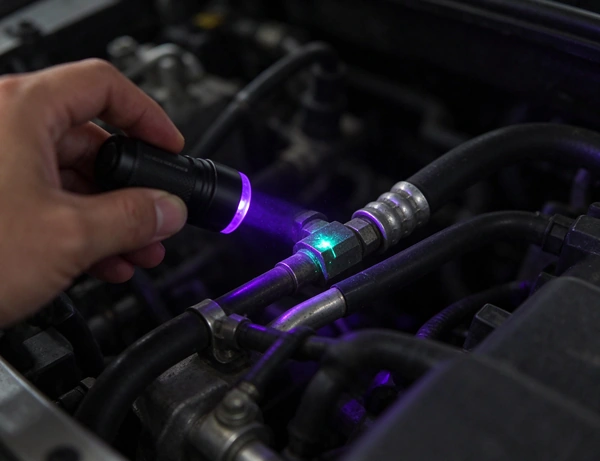
Short answer: an air conditioner on a HOWO T7H that blows slightly cool air but never cold is usually short of refrigerant, and refrigerant does not leave a sealed system on its own. If the charge is low, something leaked. Recharge without finding the leak and you will be back in the same seat next season. Measure both pressures at a fixed engine speed and vent temperature, find the leak with a detector or dye, then repair and recharge by weight.

Air conditioning is the one system on the truck where the pressure readings tell you almost everything. High side too low and low side too high means the compressor is not pumping. Both low means a charge shortage. High side too high means a restriction or an airflow problem at the condenser. Learn to read the pair and you stop guessing.
QUICK DIAGNOSIS — read the two gauges together
  1. 1Both pressures low, vent air mildly cool — undercharged. There is a leak; find it.
  2. 2High side low, low side high, compressor noisy — compressor or control valve fault.
  3. 3High side very high, cooling fades in traffic — condenser airflow, fan, or overcharge.
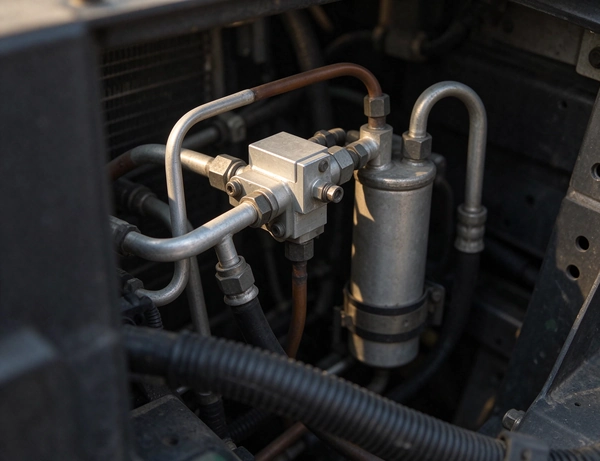
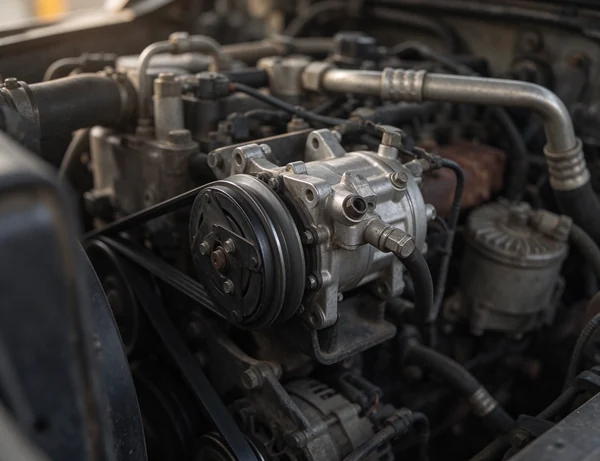
Air conditioning compressor and high and low pressure lines on a HOWO T7H engine

Compressor and both lines. The service ports are the only place the diagnosis starts.

1. Measure properly, or the numbers mean nothing

  1. Set a fixed condition. Engine at a defined speed, blower on maximum, recirculation on, doors open, ambient temperature recorded. Without a fixed condition, two readings taken minutes apart cannot be compared.
  2. Read both gauges together with the system stabilised. Let it run for several minutes so the pressures settle. A reading taken thirty seconds after start tells you nothing.
  3. Measure vent temperature in the centre outlet. This is the outcome the driver cares about, and it is the number that proves whether a repair worked.
  4. Watch the compressor clutch or the control valve. A clutch that cycles rapidly, or a control valve that never modulates, changes the pressures and misleads you about the charge.
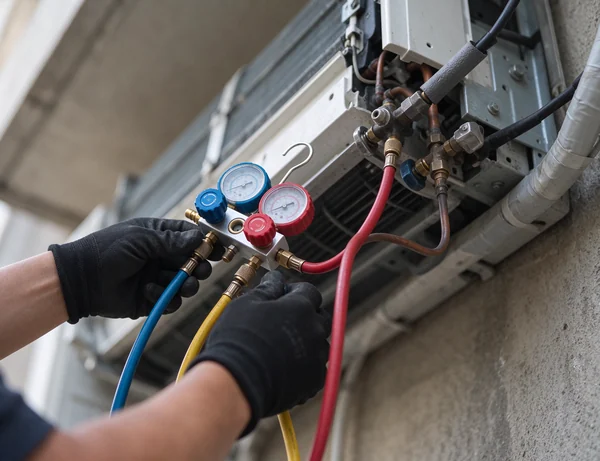
Manifold gauge set connected to the high and low pressure service ports of a truck air conditioning system

Manifold gauges on both ports. Read the pair, not one of them.

2. Leaks, and the places they hide

Location Why it leaks Test
Hose crimp joints Vibration and age at the crimp Electronic detector at the joint; look for oil-dark dust
Condenser core Stone damage, corrosion from road salt Inspect the face and the end tanks with a lamp
Compressor shaft seal Normal wear; oil residue collects dust Detector at the compressor nose, watch for oil mist
Service port valves Schrader valve not seating after a service Soap or detector at the port after disconnecting
Evaporator Corrosion and condensate Detector in the cab vents; often the last place checked
Never open a pressurised system, and never vent refrigerant to atmosphere. Liquid refrigerant at skin temperature causes instant cold burns, and venting is illegal in most markets. Recover, repair, evacuate and recharge by weight with the specified refrigerant.
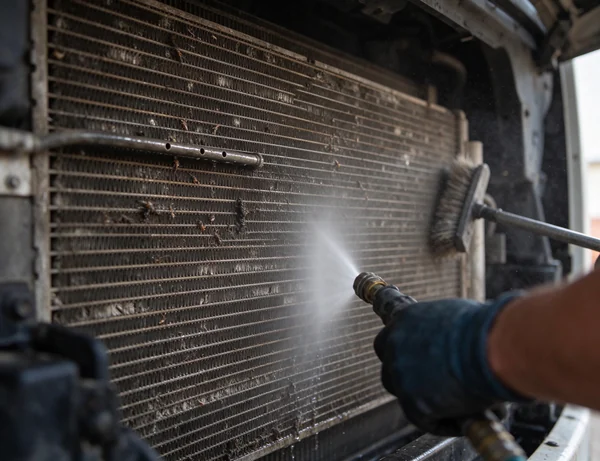
Dust and debris on the condenser face of a HOWO T7H being cleaned with water

A blocked condenser face. Cooling fades in traffic and recovers on the open road — that pattern is airflow, not charge.

3. When the charge is right and it is still warm

Three things then remain. Airflow through the condenser, which on a truck is usually a blocked core or a fan that is not pulling; airflow through the evaporator, which is a blocked filter or a recirculation flap stuck open; and the blend flap, which lets hot air past the evaporator so the vent never reaches temperature. A vent that is cold on one side and warm on the other is almost always a blend flap or a blocked evaporator section, not a refrigerant problem.

4. Questions drivers ask most

Can I top up with a can from a shop?
Not safely. Without both pressures and a known weight, you cannot tell an undercharge from a compressor fault, and an overcharge raises the high side and reduces cooling. Charge by weight after evacuation.
Why does it cool better at night?
Lower ambient temperature means the condenser can reject more heat. That points at condenser airflow or an overcharge rather than at the compressor.
Does a leaking system damage the compressor?
Yes. A low charge means less oil circulation, and a compressor running short of oil and refrigerant wears out quickly. That is why a slow leak eventually becomes a compressor replacement.
How long should a recharge last?
In a sealed system, indefinitely. If it needs gas every season, it has a leak that has never been found, and dye or a detector will find it in one session.
Need a compressor, condenser, expansion valve, hoses or a receiver drier for your T7H? Send the chassis number and we will confirm the correct air conditioning parts. Send your request

Refrigerant type, charge weight and pressure specifications vary by system. Confirm them in the OEM manual and use only the specified refrigerant with proper recovery equipment.

Need Help or Want More Detailed Maintenance Information?

Please contact our team for personalized maintenance guidance and technical support for your Sinotruk HOWO, A7, or T7 trucks. We provide professional advice and recommendations for genuine parts to help ensure the reliable operation of your fleet.

Contact Us

More Articles

Howo Sinotruk Parts & Catalog PDF

Whenever your truck needs repair, you don’t know how to buy the right parts?

Don’t worry, we have already done this job for you. We have a complete parts list catalog for different models of each truck assembly, you can choose the right catalog to download and collect according to your truck configuration.

When you have a need, you can send us your required list based on this catalog.

Obtain the complete Howo truck parts catalog PDF file and pricing.

Contact Us
Hot-Selling Replacement Parts

whatsapp-4