banner-news1
REPAIR FAQ
Back

HOWO T7H Heavy Steering: Pump, Gear and Alignment

Short answer: heavy steering on a HOWO T7H is a hydraulic or a mechanical problem, and the two are easy to separate with one question: is it heavy all the time, or only when hot or only at one lock? Heavy everywhere from cold points at pump output, belt slip or a blocked filter. Heavy only when the oil is hot points at pump wear or internal leakage in the steering gear. Heavy at one lock points at a mechanical bind — a ball joint, a kingpin or a bent linkage — and no amount of hydraulic pressure will fix it.

The T7H uses an engine-driven power steering pump feeding an integral steering gear. Because the pump is belt-driven and the oil also cools the pump, a tired belt or a restricted filter can imitate a failing gear almost perfectly. Pressure-testing the pump output takes ten minutes and prevents the most expensive mistake in this diagnosis: replacing a steering gear because the pump was weak.
QUICK DIAGNOSIS — when the heaviness appears
  1. 1Heavy from cold, better after a few minutes — cold oil, low level, or a restriction in the suction line letting the pump cavitate.
  2. 2Heavy when hot, especially at idle — pump wear or internal leakage. Output falls as the oil thins.
  3. 3Heavy turning one way only — mechanical bind in the linkage or a spool fault in the gear. Test on a level surface with the wheels off the ground.
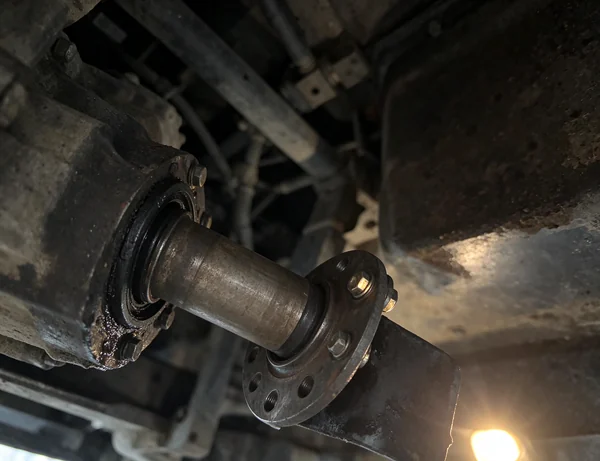
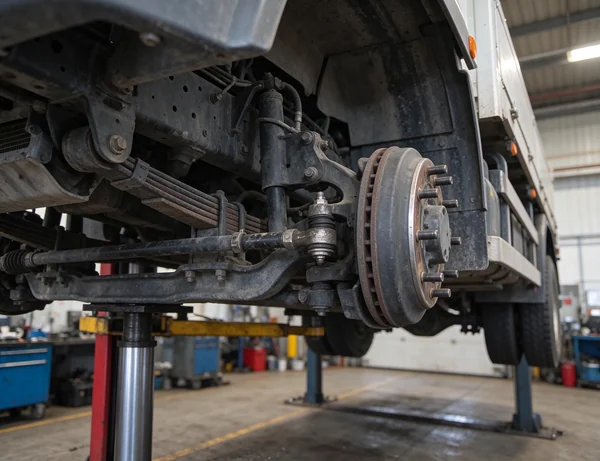
HOWO T7H front steering linkage and hub photographed on a workshop lift during a steering effort diagnosis

Start with the linkage on a lift: wheels free, engine off, and turn the wheel by hand to feel for a bind.

1. The three tests that come before any part

  1. Check the tyres and the load. Under-inflated front tyres and an overloaded front axle both raise steering effort, and neither shows up on a pressure gauge. Measure the front tyre pressures cold and compare with the axle load rating.
  2. Check the oil level and the filter. The reservoir must be at the mark with the oil at working temperature and the engine off after a short idle. A blocked suction filter starves the pump and produces heavy steering that gets worse as speed rises.
  3. Feel for a mechanical bind with the front axle raised. Engine off, wheels in the air, turn the steering wheel lock to lock by hand at the wheel. Any tight spot, any point where effort rises sharply, is mechanical and is found before the hydraulics are involved at all.
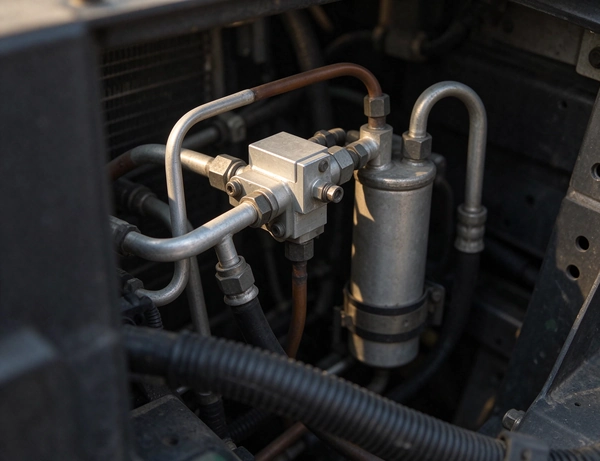
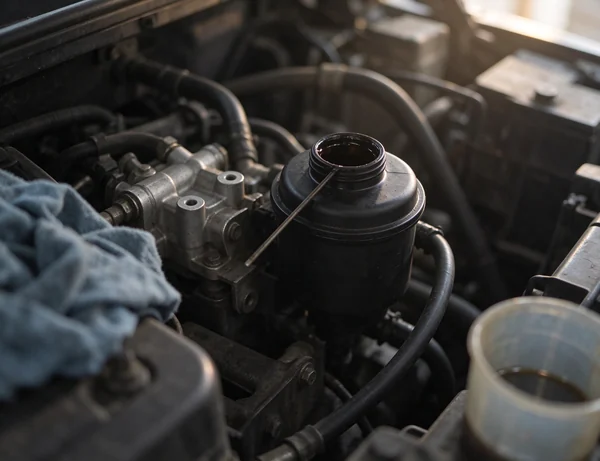
Power steering pump and reservoir on a HOWO T7H with the reservoir cap removed, showing the oil level

Pump and reservoir. The level must be read hot with the engine stopped, otherwise a low system reads as full.

2. Pressure-testing the pump, not guessing at the gear

Tee a pressure gauge into the pump delivery line and read it in three states: at idle with the wheels straight, at idle with the steering held just short of full lock, and at raised engine speed. Then compare with the figures in the manual.

  • Pressure low in all three states. The pump is worn, the relief valve is stuck open, or the belt is slipping. Check belt tension and pulley condition before condemning the pump.
  • Pressure good at idle but falls when hot. Pump wear. Internal clearances open up as the oil thins, and the pump can no longer hold pressure at low engine speed.
  • Pressure good at the pump, effort still high. The loss is downstream: internal leakage in the steering gear, a collapsed hose liner, or a blocked return filter creating back pressure.
Do not hold the steering against full lock for more than a few seconds. At full lock the pump is dead-headed and the oil temperature climbs fast. Repeated full-lock holds are one of the most common causes of seal failure in the gear and of burnt oil that then blocks the filter.

3. Fluid condition tells you the history

Oil appearance What it means Action
Clear amber, at level System healthy Continue normal service interval
Dark brown, smells burnt Overheated by full-lock holds or a restricted return Flush the system, replace the filter, find the restriction
Milky or foamy Air being drawn in on the suction side Pressure-test the suction line, check the reservoir seal
Metallic sparkle Pump or gear wearing out Flush, replace the filter, re-test pressure before replacing parts
Steering gear output shaft on a HOWO T7H showing an oil seep, checked with a torch during diagnosis

A seep at the gear output shaft is a seal, not a reason to replace the gear — unless pressure testing shows internal leakage as well.

4. When the fault is alignment, not hydraulics

Excessive toe-in or toe-out, a bent tie rod from a kerb strike, or a worn kingpin all raise steering effort and all produce a distinct tyre wear pattern. If the front tyres show feathered edges across the tread, or one shoulder scrubbed compared with the other, the alignment is doing the damage regardless of what the pump is delivering. Correct the geometry first — measuring toe with a tape and a chalk line on a level surface is enough to show a fault — and then re-assess the effort.

5. Questions drivers ask most

Can I fit a higher-pressure pump to make the steering lighter?
No. The gear, the hoses and the relief setting are designed as a system. Raising pressure overloads the gear seals and the hose burst rating, and it does not fix a mechanical bind.
Why is the steering heavier when the engine is at idle?
Pump output is proportional to engine speed. A worn pump that still performs at cruising rpm will not hold pressure at idle, which is exactly when you are manoeuvring.
Does a leaking hose cause heavy steering?
A leaking pressure hose loses flow and volume, so yes. A collapsed internal liner on the return side is more subtle: the outside looks perfect and the steering still feels heavy, because back pressure fights the gear.
How often should the power steering filter be changed?
At the interval in the manual, and immediately after any pump or gear replacement, because a new component will be destroyed by debris left from the old one.
Need a power steering pump, steering gear, filter or front linkage parts for your T7H? Send the chassis number and we will confirm the correct specification for your build. Send your request

Steering pressure figures, relief settings and alignment values are build-specific. Confirm them in the OEM workshop manual for your chassis before adjusting or replacing hydraulic components.

Need Help or Want More Detailed Maintenance Information?

Please contact our team for personalized maintenance guidance and technical support for your Sinotruk HOWO, A7, or T7 trucks. We provide professional advice and recommendations for genuine parts to help ensure the reliable operation of your fleet.

Contact Us
More Articles

Howo Sinotruk Parts & Catalog PDF

Whenever your truck needs repair, you don’t know how to buy the right parts?

Don’t worry, we have already done this job for you. We have a complete parts list catalog for different models of each truck assembly, you can choose the right catalog to download and collect according to your truck configuration.

When you have a need, you can send us your required list based on this catalog.

Obtain the complete Howo truck parts catalog PDF file and pricing.

Contact Us
Hot-Selling Replacement Parts

whatsapp-4