banner-news1
REPAIR FAQ
Back

HOWO T7H Soft Brake Pedal: Air, Valve or Fade Checks

Short answer: a soft pedal on a HOWO T7H is a pressure problem, not a lining problem. In most cases the circuit is holding less air than the pedal is asking for, because of a leaking foot brake valve, a spring chamber that has crept out of adjustment, or air sitting in a line that nobody bled after the last repair. Work the circuit in order — stored pressure, static leak rate, valve exhaust, then pushrod stroke — and you find it in about twenty minutes with a pressure gauge and a bottle of soapy water.

The T7H runs a dual-circuit air system with a treadle valve feeding front and rear circuits separately. That split is useful: if the pedal is soft but the truck still stops on one circuit, the fault is usually in the circuit that has lost air, not in the valve body itself. Read the two circuit pressures separately before condemning anything.
QUICK DIAGNOSIS — read the pedal before you open a line
  1. 1Pedal travels further each stop, then firms up on a second pump — air in a circuit or a valve passing internally.
  2. 2Pedal is soft from cold and stays soft — low stored pressure, governor cut-out too low, or a compressor that is not keeping up.
  3. 3Pedal is firm when cold and goes long when hot — drum brake adjustment, glazed linings or a dragging brake, not the air circuit.
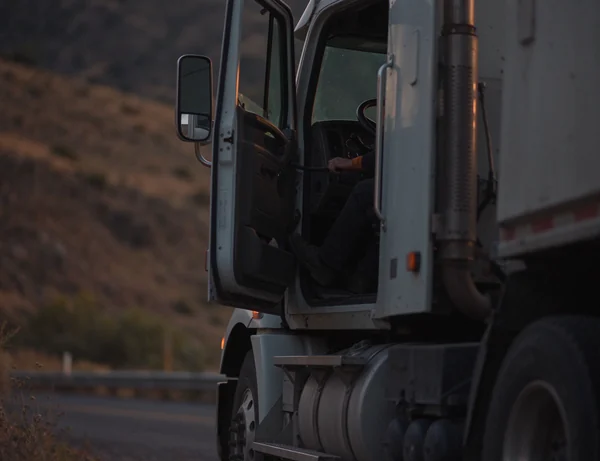
HOWO T7H tractor unit at dusk with the cab door open, driver applying the foot brake during a pedal feel test

A pedal feel test done standing still with the engine off separates an air fault from a foundation brake fault.

1. Establish what the pedal is actually doing

Three words get used for the same complaint and they mean different things. Get the driver to describe the pedal precisely, because the words point at different parts of the system:

  • Long — the pedal travels a lot before anything happens, then brakes normally. This is a volume problem: the system needs more air than the valve is delivering.
  • Soft or spongy — the pedal keeps sinking while you hold it. Air is being compressed somewhere, or a valve is passing.
  • Low — the pedal feels normal but braking is weak. The air side is fine; the foundation brake side is not.

Write down which circuit drops. On the T7H the front and rear circuits have separate reservoirs and separate warning switches. A gauge on each circuit while the driver holds the pedal tells you which half of the system is losing pressure, and that halves the search.
2. Static leak test before any road test

  1. Build full pressure and stop the engine. Record both circuit pressures. Let the truck sit with the parking brake released, wheels chocked, and watch the gauges for the interval your workshop manual specifies. A circuit that falls faster than the other is the one with the leak.
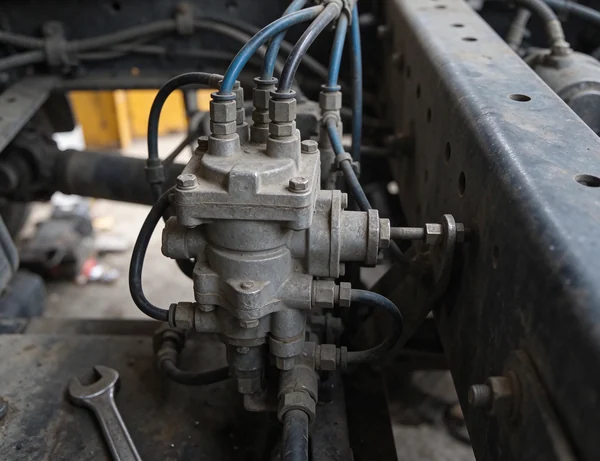
  2. Listen at the valve. With the pedal released, the treadle valve exhaust port should be silent. A continuous hiss means the valve is not seating — dirt on the seat, a scored piston or a tired return spring.
  3. Soap the joints, not the hoses. Leaks that matter usually sit at push-fit connectors, at the compressor discharge line, and at the drain valves on the reservoirs. Brush soapy water on and watch for the bubble that grows, not the one that just glistens.
  4. Check the compressor cut-out. If pressure tops out low, the governor is cutting out early or the compressor is worn. A system that never reaches its design pressure feels soft no matter how good the valve is.
Foot brake valve assembly mounted on the frame rail of a HOWO T7H, with a wrench on the exhaust port during a leak check

The treadle valve and its exhaust port. A hiss here with the pedal released is internal leakage, not a hose.

3. Bleeding air out of the circuit correctly

Air gets into an air brake system through two doors: a line that was opened and refilled without bleeding, and a reservoir that ran dry long enough for the compressor to push vapour through. Once air is in, the pedal feels spongy because air compresses where fluid would not.

Bleed at the furthest point from the valve, one wheel at a time, with the reservoir held at working pressure and a helper holding the pedal down while you crack the bleeder. Close the bleeder before the pedal returns, or the system pulls air straight back in. Repeat until the stream is air-free, then re-check the static leak rate — bleeding does not fix a leak, it only removes the symptom the leak created.

Never adjust a slack adjuster to shorten pedal travel. Shortening the pushrod stroke to make the pedal feel better on a worn brake leaves the chamber partially applied, and a partially applied spring chamber overheats the drum and can crack the lining. Set the stroke to the marked dimension, no shorter.

4. Foundation brake checks that look like air faults

Symptom Air-side cause Foundation-side cause
Pedal long, brakes weak Low reservoir pressure, leaking valve Pushrod stroke too long, automatic adjuster not ratcheting
Pedal sinks while held Internal leak in treadle valve or relay valve Rare — check for a leaking wheel cylinder on hydraulic-equipped axles
Pedal long only when hot None Drum expansion, glazed linings, dragging brake
One wheel locks, others weak Restricted line or faulty quick-release valve Oil-contaminated lining on that wheel
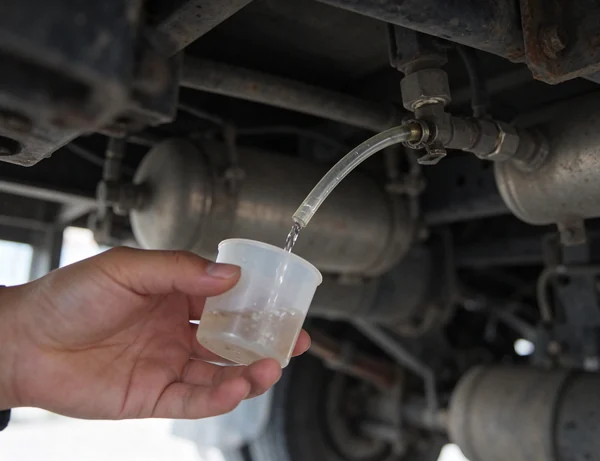
Reservoir drain valve on a HOWO T7H discharging air and condensate water into a clear cup

Drain the reservoirs weekly. Water in the system reaches the valve first and destroys the seats.

5. Why the pedal comes back soft two weeks later

If the same complaint returns after a repair, one of three things was missed: the air dryer was never serviced, so moisture kept entering the circuit; the treadle valve was cleaned instead of replaced, so a scored seat kept passing; or the compressor is pumping oil past its rings, and oil in the air system ruins every rubber seal it touches. Oil in the reservoir — a black film on the drain valve — is the giveaway, and it means the dryer cartridge and the compressor both need attention.

6. Questions drivers ask most

If I pump the pedal twice and it gets hard, is that air?
Usually yes. A second application gives the valve another chance to seat, so the pedal firms. That points at a passing valve seat or a slow internal leak, not at worn linings.
Can I drive with a soft pedal to the next town?
Only if both circuits hold pressure and the truck stops in a controlled stop from walking speed. A soft pedal that is losing pressure is a breakdown, not a maintenance item — the second circuit is your only reserve and it may be the one leaking.
Does the air dryer affect pedal feel?
Yes, indirectly. A saturated dryer passes moisture into the circuit, moisture corrodes valve seats and freezes in winter, and a corroded seat is exactly what makes a pedal sink.
What pressure should a T7H hold?
The governor cut-out figure in the workshop manual for your build, typically in the region of 8 to 10 bar. What matters more than the absolute number is that both circuits reach it and that neither falls away while standing.
Need a treadle valve, relay valve, spring chamber or slack adjuster for your T7H? Send the chassis number and we will confirm the correct air circuit specification. Send your request

Air pressure limits, pushrod stroke dimensions and leak-rate limits vary by build and by local regulation. Confirm the figures for your chassis in the OEM workshop manual before adjusting any brake component.

Need Help or Want More Detailed Maintenance Information?

Please contact our team for personalized maintenance guidance and technical support for your Sinotruk HOWO, A7, or T7 trucks. We provide professional advice and recommendations for genuine parts to help ensure the reliable operation of your fleet.

Contact Us
More Articles

Howo Sinotruk Parts & Catalog PDF

Whenever your truck needs repair, you don’t know how to buy the right parts?

Don’t worry, we have already done this job for you. We have a complete parts list catalog for different models of each truck assembly, you can choose the right catalog to download and collect according to your truck configuration.

When you have a need, you can send us your required list based on this catalog.

Obtain the complete Howo truck parts catalog PDF file and pricing.

Contact Us
Hot-Selling Replacement Parts

whatsapp-4