

Short answer: An internal leak in the clutch master or slave cylinder produces a fault with no visible oil: the pedal holds at first, then sinks slowly, and after a few hours the clutch will not release properly. Because there is no leak on the floor, the fault is often misdiagnosed as an air problem or a worn clutch, and parts are replaced until the real cylinder is found.
The test is simple and decisive: hold steady pressure on the pedal and time how long it takes to sink. A healthy system holds almost indefinitely, and a leaking one sinks progressively.
Then separate the master from the slave by clamping the line and repeating the test.
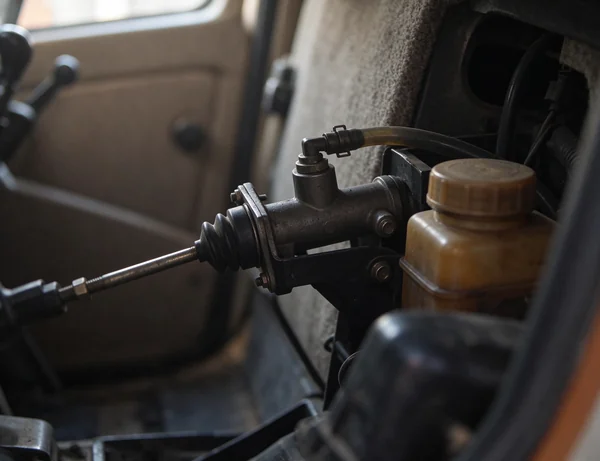
Press the pedal firmly and hold it for 30 to 60 seconds. A system that holds its position is sound; one that sinks is losing fluid past a seal, internally or externally.
Then check for external leakage at the slave, the line and the master. If nothing is wet, the leak is internal and the pushrod seal is the usual culprit.
Clamping the line is the quickest split. If the pedal stops sinking, the master is holding and the slave is leaking; if it still sinks, the master is the faulty part.
Both cylinders are inexpensive compared with the cost of replacing a clutch that was never the problem, so proving the fault pays for itself.
| Test result | Faulty part | Note |
|---|---|---|
| Pedal holds after clamping | Slave cylinder | Seal passing under pressure |
| Pedal sinks after clamping | Master cylinder | Pushrod seal worn |
| Fluid drops, no external leak | Either cylinder internally | Confirm with the clamp test |
| Pedal spongy, recovers on pumping | Air in the system | Bleed, then re-test |
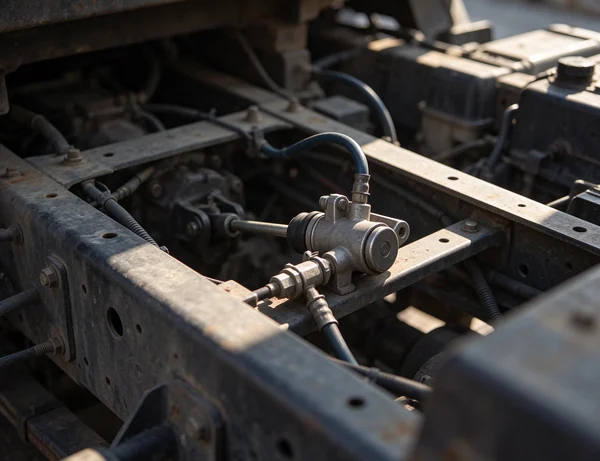
Replace the failed cylinder rather than resealing it, and replace the fluid if it has been contaminated. Bleed the system properly from the lowest point and confirm the pedal holds and the fork reaches full stroke.
A repair that is not followed by a pedal hold test and a road test is likely to return, because the second cylinder often fails shortly after the first.
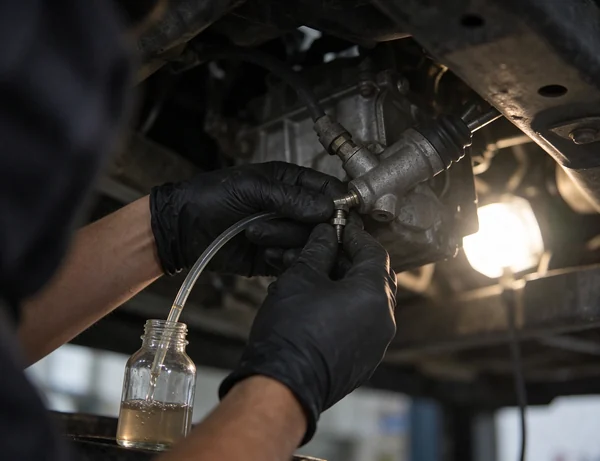
Fluid specification and cylinder part numbers are model specific. Confirm them in the OEM manual.
Please contact our team for personalized maintenance guidance and technical support for your Sinotruk HOWO, A7, or T7 trucks. We provide professional advice and recommendations for genuine parts to help ensure the reliable operation of your fleet.
Contact Us
Whenever your truck needs repair, you don’t know how to buy the right parts?
Don’t worry, we have already done this job for you. We have a complete parts list catalog for different models of each truck assembly, you can choose the right catalog to download and collect according to your truck configuration.
When you have a need, you can send us your required list based on this catalog.
Obtain the complete Howo truck parts catalog PDF file and pricing.
Contact Us
2001-2026 Shandong Yimo Auto Sales Co., Ltd. © All rights reserved.


