

Short answer: An engine knock is located by three tests, not by listening harder. Cut one injector at a time: a knock that disappears is a bottom end bearing on that cylinder, and a knock that stays is top end or front end. Then change load: a knock that follows load is mechanical, and one that appears only at a certain speed is usually combustion. Confirm with oil pressure, because a bottom end knock almost always comes with a pressure drop.
Drivers describe every unusual noise as a knock. The useful split is between a noise that is harmless at low load and a noise that means stop now. A deep, dull thud at idle that grows into a hammer under load is the one that ends with a crankshaft, and it is always accompanied by something you can measure.
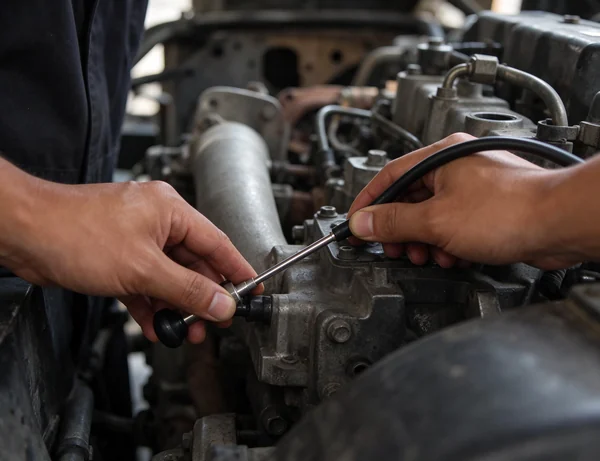
With the engine idling warm, disable one injector at a time through the diagnostic tool and listen. Removing fuel from a cylinder with a worn rod or main bearing removes the load and the knock goes quiet. Removing fuel from a healthy cylinder makes its own contribution disappear and the knock stays the same.
Do not cut out cylinders for more than a few seconds each, and do not run the engine at load during the test. The point is to identify, not to prove how long the bearing lasts.
Combustion knock appears under load and often disappears when the engine is cold, because cold air is denser and the ignition delay is shorter. Bearing knock behaves the opposite way: it is clearest when the oil is hot and thin.
Front end noise is the easiest to rule out. Remove the belt and run the engine for less than a minute: if the noise disappears, the fault is in an accessory or a tensioner, not inside the engine.
| Behaviour | Most likely source |
|---|---|
| Quiet when the cylinder is cut | Rod or main bearing on that cylinder |
| Louder when the engine is hot, quiet cold | Bearing, oil film thinning with temperature |
| Louder when cold, quieter hot | Combustion knock or a piston slap |
| Disappears with the belt removed | Accessory drive, tensioner or pump bearing |
| Only at one road speed | Driveline or an engine mount resonance |
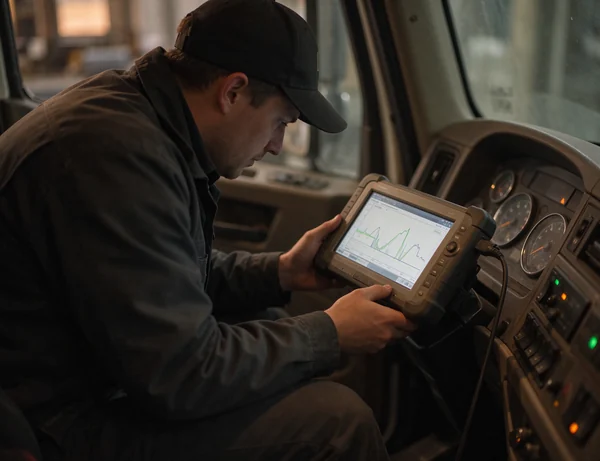
A confirmed bottom end knock ends the diagnosis phase. Stop the engine, remove the sump and inspect the bearing shells on the cylinder the cut-out test named. A shell with a wiped overlay, a dark heat mark or a spun insert tells you the crank journal needs measuring before a new set goes in.
Never fit new shells to a journal that has not been measured. Clearance out of tolerance is what destroyed the first set, and the second set will follow within a few hundred kilometres.
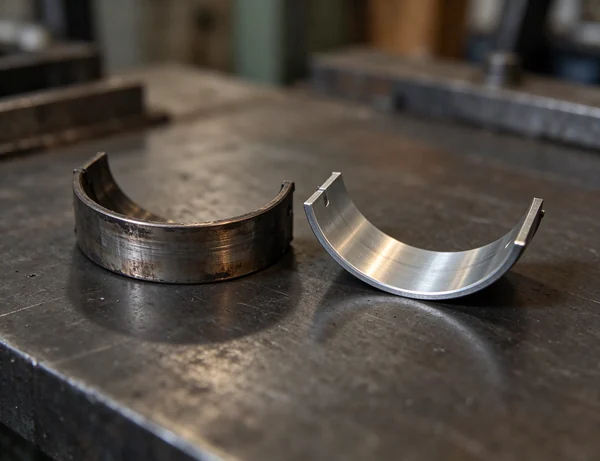
Bearing clearances, torque figures and cut-out procedures are engine specific. Follow the OEM manual and the diagnostic tool instructions.
Please contact our team for personalized maintenance guidance and technical support for your Sinotruk HOWO, A7, or T7 trucks. We provide professional advice and recommendations for genuine parts to help ensure the reliable operation of your fleet.
Contact Us

Whenever your truck needs repair, you don’t know how to buy the right parts?
Don’t worry, we have already done this job for you. We have a complete parts list catalog for different models of each truck assembly, you can choose the right catalog to download and collect according to your truck configuration.
When you have a need, you can send us your required list based on this catalog.
Obtain the complete Howo truck parts catalog PDF file and pricing.
Contact Us
2001-2026 Shandong Yimo Auto Sales Co., Ltd. © All rights reserved.


