

Short answer: a truck that runs hot in summer and normal in winter is telling you it has almost no cooling margin left. In hot weather the same radiator has to reject more heat with a smaller temperature difference, so every weakness — a partly blocked core, a tired fan clutch, a collapsing hose, a weak cap — becomes visible. The right response is to measure the margin: temperature at the thermostat housing, at the radiator inlet and outlet, and the fan’s behaviour. Those three temperatures identify the component in one session.
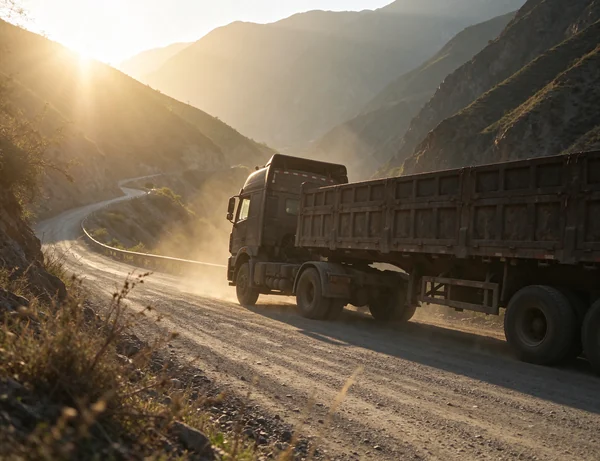
Cooling systems do not usually fail suddenly. They lose margin. A radiator that is 20 percent blocked works perfectly in a mild climate and fails on the first long climb at 40 degrees. That is why summer overheating should be diagnosed as a loss of margin rather than treated as an emergency each time it happens.
| Cause | Effect | Test |
|---|---|---|
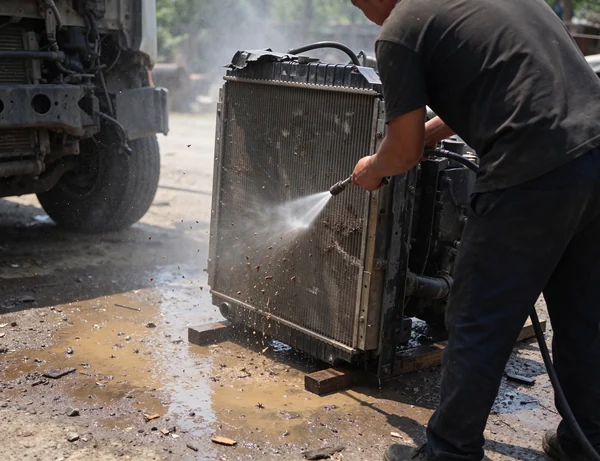
| Blocked or dirty core | Less airflow and less heat rejection | Inspect the fins with a lamp; measure the difference across the core |
| Collapsing hose | Flow restricted at high pump speed | Rev the engine and watch the hose for collapse |
| Weak fan clutch | Insufficient airflow when hot | Compare fan speed hot and cold; feel the airflow |
| Early-opening cap | Lower boiling point, coolant loss | Pressure test the cap and the system |
| Over-fuelling or a restricted intake | More heat into the coolant for the same power | Check boost and exhaust temperature; look for black smoke |
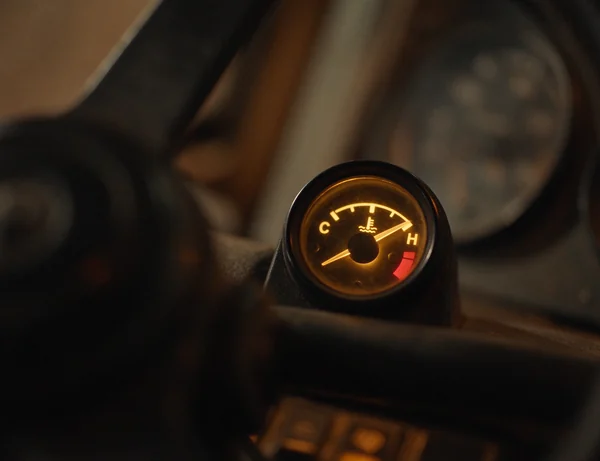
When a truck starts to run hot on a climb, the correct response is to reduce load and downshift, not to keep the throttle down and watch the gauge. A lower gear raises fan and pump speed and reduces the heat the engine has to reject for the same road speed. Turning the heater on full is a legitimate emergency measure, because the heater core is a second radiator. What is not legitimate is continuing to the top of the climb with the gauge in the red, because the failure that follows is a head gasket or a cracked head, and that repair is far more expensive than stopping.
Thermostat opening temperatures, cap pressures and fan engagement specifications are engine-specific. Confirm them in the OEM manual before replacing cooling components.
Please contact our team for personalized maintenance guidance and technical support for your Sinotruk HOWO, A7, or T7 trucks. We provide professional advice and recommendations for genuine parts to help ensure the reliable operation of your fleet.
Contact Us
Whenever your truck needs repair, you don’t know how to buy the right parts?
Don’t worry, we have already done this job for you. We have a complete parts list catalog for different models of each truck assembly, you can choose the right catalog to download and collect according to your truck configuration.
When you have a need, you can send us your required list based on this catalog.
Obtain the complete Howo truck parts catalog PDF file and pricing.
Contact Us
2001-2026 Shandong Yimo Auto Sales Co., Ltd. © All rights reserved.


