

Short answer: Low oil pressure on an MC11 has four possible owners: the sender or gauge, the oil pump, the relief valve stuck open, and air entering the suction side. Prove the reading with a mechanical gauge before anything is removed. If the mechanical gauge agrees with the dash, the order of work is suction side, relief valve, then pump, because the first two cost a fraction of the third.
The warning usually appears at hot idle in traffic, then disappears as soon as the driver revs the engine. That pattern is the useful clue: pressure that is only low when hot and at low speed points at a worn pump or a relief valve that is bleeding off too early, while pressure that is low at every speed points at a suction leak or a blocked pickup.
Oil pressure is the cheapest early warning the engine gives you. Ignoring it for a week is how a bearing set and a crankshaft become one invoice.
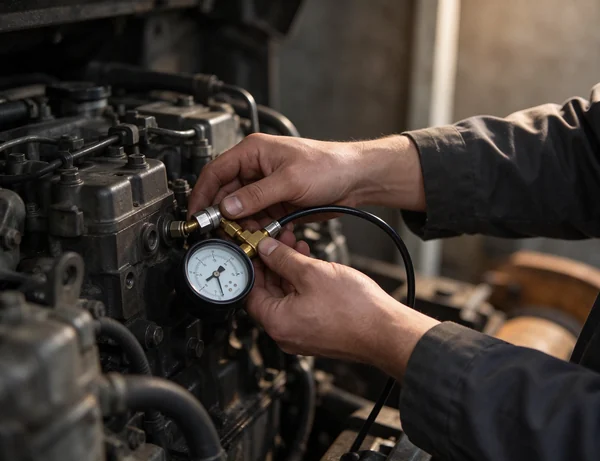
Thread a mechanical gauge into the main oil gallery port, run the engine to operating temperature, and record the pressure at idle and at a steady 1500 to 2000 rpm. Write both numbers down with the oil temperature beside them, because pressure is meaningless without temperature.
If the mechanical numbers match the dash, the fault is real. If they do not, the sender, its wiring or its earth is the fault, and no amount of engine work will change the reading.
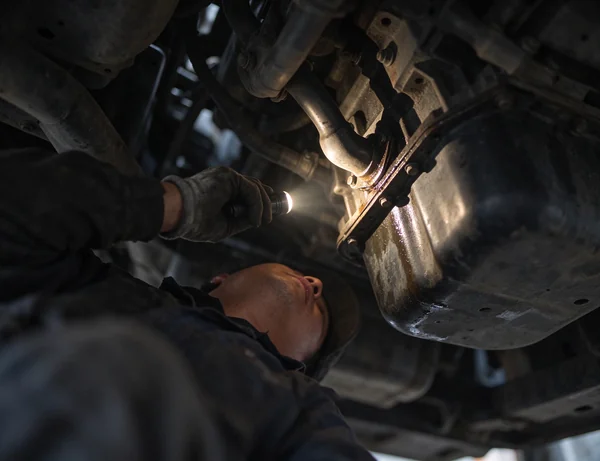
Air on the suction side is the most common cause of a pressure reading that falls as the oil warms. Check the pickup pipe joint, the oil pump inlet seal and the sump gasket for a crack or a loose bolt. A suction leak often leaves oil seeping at the joint when the engine is stopped, which is the easiest confirmation you will get.
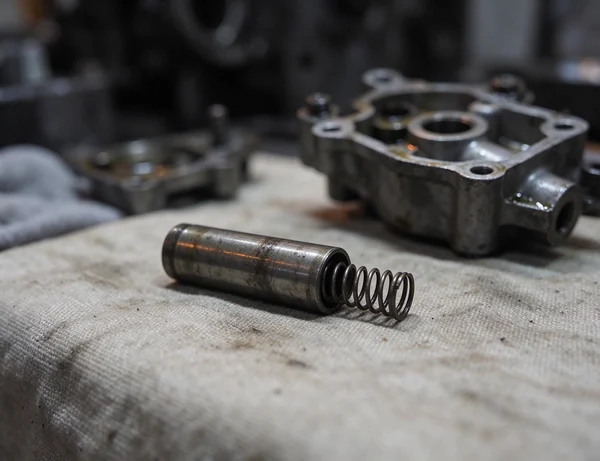
The relief valve is a spring loaded plunger. A plunger that is scored, stuck part open, or fitted with a broken spring will bleed pressure continuously. It is a small part and it is accessible on most builds without removing the pump.
| Finding | Probable cause | Next step |
|---|---|---|
| Pressure low hot only, recovers with revs | Pump wear or relief valve | Inspect the valve, measure pump clearance |
| Pressure low at all speeds | Suction leak or blocked pickup | Inspect the pipe joint and the screen |
| Pressure drops when the engine is loaded | Bearing clearance opened up | Oil sample and bearing inspection |
| Oil dark and metallic at the drain plug | Bearing material | Stop driving, strip and inspect |
Thicker oil will raise the number on the gauge and hide the fault for a few thousand kilometres. It will not repair a worn pump, and it will reduce cold start flow exactly when the bearings need it most.
The same applies to a new sender fitted to silence a warning. If the mechanical gauge shows a real loss, replacing the sender converts a cheap repair into a seized engine.
Pressure ranges, oil grades and pump clearances are engine variant specific. Confirm them in the OEM manual before replacing parts.
Please contact our team for personalized maintenance guidance and technical support for your Sinotruk HOWO, A7, or T7 trucks. We provide professional advice and recommendations for genuine parts to help ensure the reliable operation of your fleet.
Contact Us

Whenever your truck needs repair, you don’t know how to buy the right parts?
Don’t worry, we have already done this job for you. We have a complete parts list catalog for different models of each truck assembly, you can choose the right catalog to download and collect according to your truck configuration.
When you have a need, you can send us your required list based on this catalog.
Obtain the complete Howo truck parts catalog PDF file and pricing.
Contact Us
2001-2026 Shandong Yimo Auto Sales Co., Ltd. © All rights reserved.


