

Short answer: A turbocharger seal is not designed to hold oil pressure. It relies on the oil draining freely back to the sump, so a restricted or partly blocked return pipe raises crankcase pressure behind the seal and oil is pushed past it. Fitting a new turbo without checking that return means the new unit leaks within weeks, and the second complaint is always about the part rather than the pipe.
Oil enters the turbo bearing at pressure and leaves by gravity into a pipe that runs down to the sump. Any restriction in that pipe, in the flange or in the sump fitting builds pressure at the seal.
The signs are oil in the charge air system, oil at the compressor inlet, blue smoke at idle and, in the worst case, oil being pushed into the intercooler.
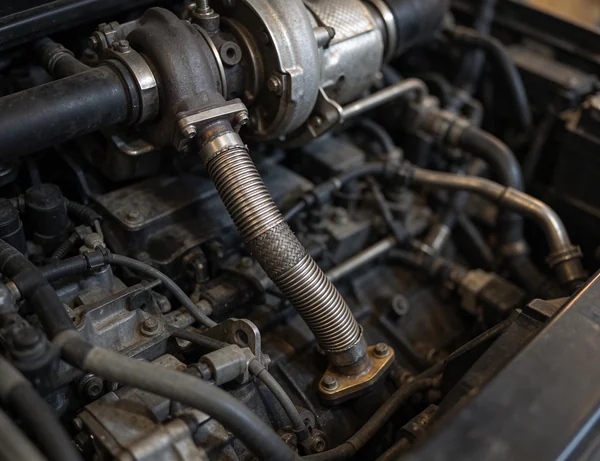
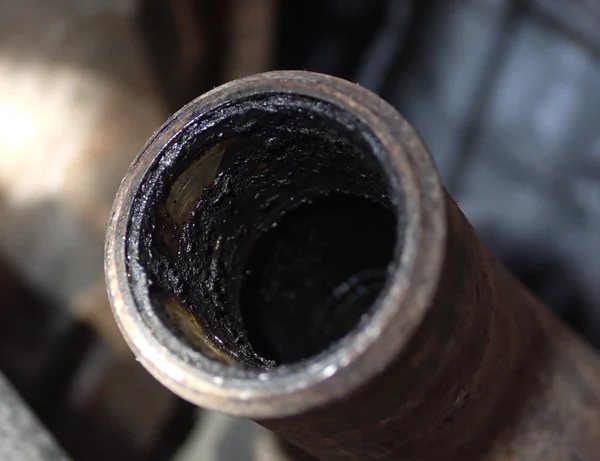
Remove the return pipe and inspect it internally. Carbon and sludge build up where the pipe is hottest and where it bends, and a pipe that looks clear from the outside can be half closed inside.
Check the sump fitting and the flange for a gasket that has been fitted with the wrong hole size, or a restrictor left in place that should not be there.
Crankcase pressure and drain restriction produce the same result. A blocked breather raises pressure in the sump, and the drain cannot flow against it, so oil is pushed past both the turbo seal and the rear main seal.
Check the breather filter or the crankcase ventilation valve at the same time as the drain. Fixing one and not the other usually produces a leak somewhere else within a few hundred hours.
| Check | Normal | Fault |
|---|---|---|
| Return pipe internal | Clear bore | Carbon or sludge restriction |
| Crankcase pressure | Low, stable | Rises with load |
| Turbo shaft play | Within limit | Excessive movement |
| Charge air oil | Minimal film | Heavy oil present |
Fit a clean, unobstructed return pipe with new gaskets, and make sure the pipe is not strained or bent to fit. A pipe that is under tension can crack at the flange after a few heat cycles.
Prime the new turbo with clean oil before the first start, then idle for a few minutes without load before driving. A turbo that starts dry wears its bearings within seconds.
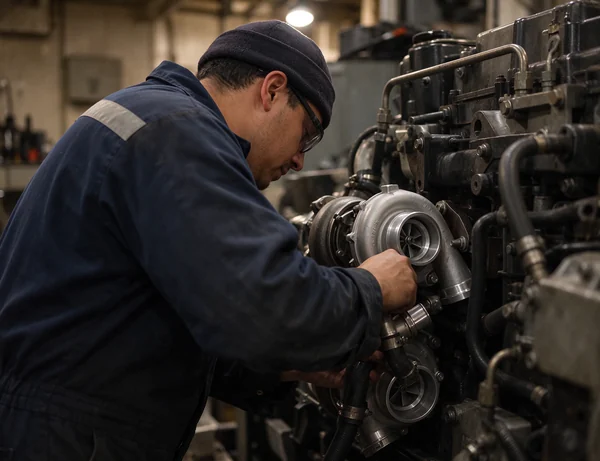
Oil supply and return layout differs by engine. Confirm the pipe arrangement in the OEM parts list.
Please contact our team for personalized maintenance guidance and technical support for your Sinotruk HOWO, A7, or T7 trucks. We provide professional advice and recommendations for genuine parts to help ensure the reliable operation of your fleet.
Contact Us

Whenever your truck needs repair, you don’t know how to buy the right parts?
Don’t worry, we have already done this job for you. We have a complete parts list catalog for different models of each truck assembly, you can choose the right catalog to download and collect according to your truck configuration.
When you have a need, you can send us your required list based on this catalog.
Obtain the complete Howo truck parts catalog PDF file and pricing.
Contact Us
2001-2026 Shandong Yimo Auto Sales Co., Ltd. © All rights reserved.


