Short answer: a truck that will not start in cold weather has one of three problems — the engine is not cranking fast enough (battery, cables or starter), the fuel has waxed or the filter is clogged, or the pre-heat system is not working. You can separate all three in five minutes: listen to the cranking speed, look at the transparent filter bowl, and feel the intake or glow circuit. Each points to a completely different repair.
Cold-start faults are the most misdiagnosed category on any diesel fleet, because everything looks like “the battery”. Cranking speed is the first thing to judge, and it is judged by ear and by the sound of the starter, not by a voltage reading taken at rest.
QUICK DIAGNOSIS — three checks, five minutes
- 1Cranking too slow. Battery capacity, corroded terminals or a tired starter. The engine turns but never reaches starting speed.
- 2Fuel waxed or filter clogged. The engine turns at normal speed, fires briefly, then dies.
- 3Pre-heat not working. Normal cranking, no fire at all, and the intake is cold to touch.
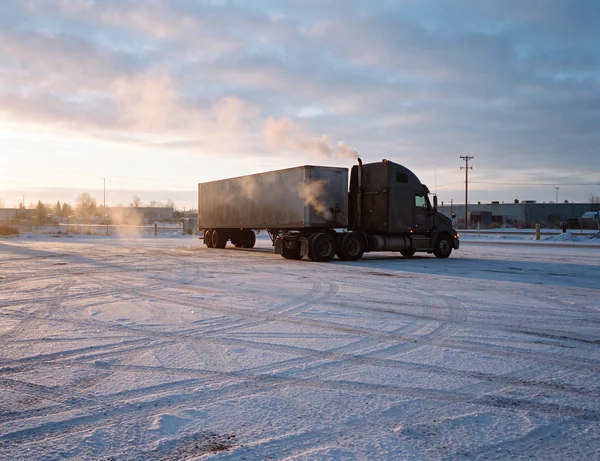
A cold morning start. White vapour in the first minute is normal; white smoke that never clears is not.
1. Judge cranking speed first
A cold diesel needs to reach a minimum cranking speed before compression generates enough heat to ignite fuel. If the engine turns slowly, no amount of pre-heating or throttle will help.
- Listen to the rhythm. A healthy cold crank is fast and even. A slow, laboured crank that speeds up when the engine warms indicates a battery or cable problem, not compression.
- Check the terminals and the earth strap. White-green corrosion on a terminal adds resistance that no battery can overcome. Remove, clean to bare metal, and re-clamp.
- Do a voltage-drop test, not a resting voltage test. Measure during cranking from the battery positive post to the starter positive stud, and from the starter body to the battery negative post. A significant drop across either leg means high resistance in a cable or joint — and this is the fault most often missed when a new battery does not fix the problem.
- Check the charging system afterwards. A battery that is only half charged at the end of a shift will not start the truck on a cold morning, whatever its rating.
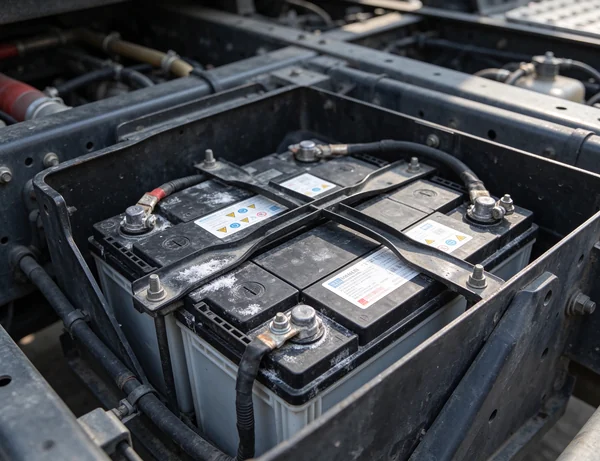
Battery box in freezing conditions. Frost on the case is normal; corrosion at the terminal is not.
2. Fuel: wax, water and filter
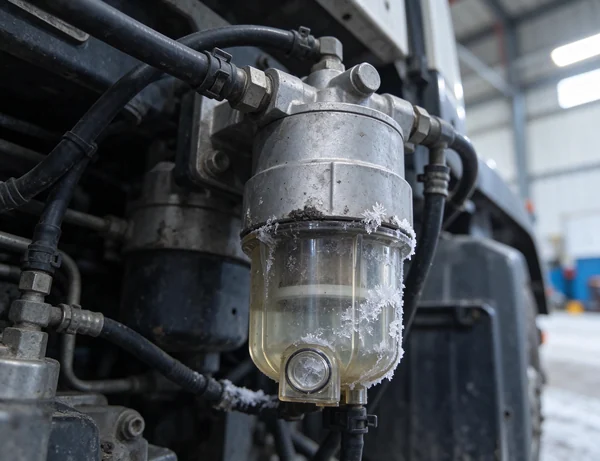
The transparent bowl is a diagnostic window. Wax and water both show up here before the engine complains.
- Read the bowl. A clear bowl with diesel at the line is good. A cloudy, waxy layer, or a visible water band at the bottom, means the filter is doing its job and the fuel is the problem.
- Match the grade to the weather. Summer-grade diesel begins to wax a few degrees below zero. In sustained cold, the fuel must be the winter grade sold for that climate, not last season’s tank contents.
- Drain the water separator every day in winter. Water freezes in the filter and blocks flow completely — a truck can be perfectly fuelled and still not start because of a thimble of ice.
- Check the pre-heater circuit. The filter heater and the fuel line heater must actually warm. Feel the housing after the ignition has been on for a minute: cold housing means the heater circuit is open.
- Look for air ingress. A filter seal that has hardened lets air in. The engine fires, runs for a few seconds, then dies — the classic signature of a filter that is not sealing.
Never add petrol to diesel to improve cold starting. It raises the cetane problem instead of solving it, reduces lubricity and can damage the high-pressure pump and injectors. It is a false economy that turns a cold-start complaint into a fuel-system overhaul.
3. Pre-heat and the first thirty seconds
- Confirm the pre-heat actually runs. Watch the dash indicator, then feel the intake manifold or the glow area. No warmth after the specified pre-heat time means the circuit is open — relay, fuse, element or controller.
- Do not crank continuously. Long cranking overheats the starter and drains the battery further. Crank in short bursts with a pause between them, and let the pre-heat cycle repeat if the system allows it.
- Start with the throttle closed. Pushing the throttle while cranking adds fuel to a cold chamber and produces the white smoke drivers complain about.
- Let it idle briefly, then load gently. Oil needs a moment to reach the turbo bearing. Loading a cold engine immediately is what shortens turbo life in winter.
- Watch the first minute of exhaust. White vapour that clears is condensation. White smoke that continues for minutes is unburned fuel — pre-heat, injector or compression.
4. Symptom to cause
5. Mistakes that make winter worse
Do not use starting fluid on a pre-heated diesel. An intake heater or glow plug can ignite the ether early, and the resulting pressure spike damages the engine. It is also the fastest way to crack a piston ring land.
- Replacing the battery without checking the cables. A corroded earth strap makes a new battery behave like an old one.
- Running summer fuel into winter. The tank holds the previous grade for a long time; plan the change before the first frost, not after.
- Ignoring the water separator. Ice in the filter is the single most common “no start” cause that costs nothing to prevent.
- Long cranking sessions. They flatten the battery and overheat the starter, turning a fuel problem into two problems.
6. Questions drivers ask most
My truck cranks fast but will not fire. Is it the battery?
No. Fast cranking means the battery and starter are doing their job. Look at fuel — wax, ice in the filter, or air ingress at the filter seal.
Can I use a booster to start it every morning?
Occasionally, yes, but if you need it daily the battery is undersized, undercharged or at end of life. Boosters also mask a cable fault that will eventually leave you stranded.
Why does it start after I let it sit for ten minutes?
That is usually heat soaking into the combustion chamber from a warm engine bay, or wax dissolving after the filter heater has had time to work. Both point to a marginal pre-heat or fuel-grade issue, not to the starter.
Should I drain the fuel filter every morning in winter?
Drain the water separator at the end of every shift in freezing conditions, not just in the morning. Water left overnight is water that will be ice by morning.
Need batteries, a starter, a pre-heat element or winter-grade filter kits for your Sinotruk truck? Send the chassis number and we will match the parts.
Send your requestBattery ratings, pre-heat times and fuel grades depend on your market and build. Confirm the specification and the manual procedure for your chassis before servicing.